Quick answer (updated November 2026): The biggest student visa changes of 2026 in the four main English-speaking study destinations are:
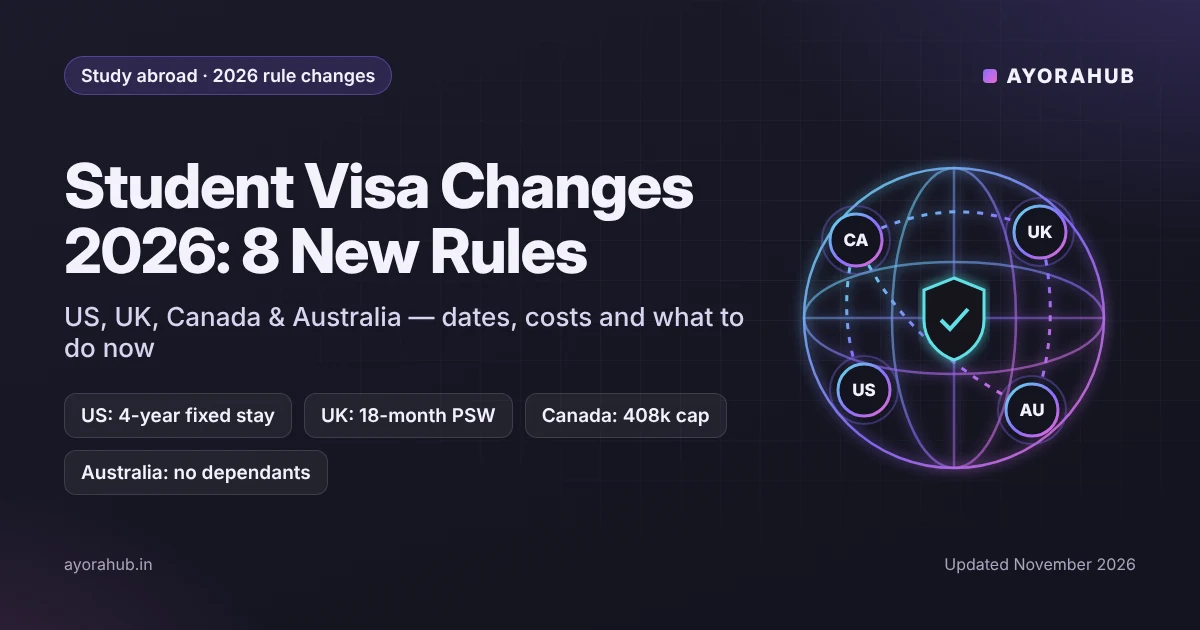
- United States: from 15 September 2026, F-1 students are admitted for a fixed period of up to 4 years instead of “duration of status”, and the grace period after your programme falls from 60 to 30 days.
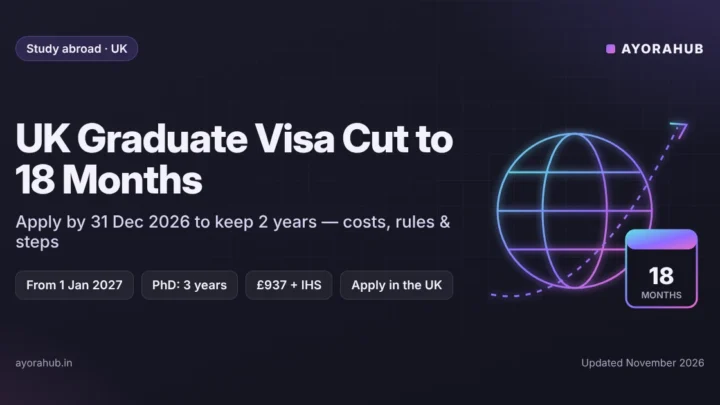
- United Kingdom: the Graduate visa drops from 2 years to 18 months for applications made on or after 1 January 2027, and students must show more money: £1,529 a month in London or £1,171 elsewhere.
- Canada: the 2026 cap is 408,000 study permits, of which only 155,000 are for new arrivals. Master’s and PhD students at public institutions no longer need an attestation letter, and proof-of-funds amounts rose on 1 September 2026.
- Australia: the student visa now costs from A$2,500. Since 2 October 2026, most students cannot include family members and must generally apply from outside Australia.
If you are planning to study abroad in 2027, the rules you read about a year ago may no longer apply. This guide puts the eight changes that matter most on one page, with the exact dates and the official source for each, so you can check them yourself before you pay a deposit or book a visa appointment.
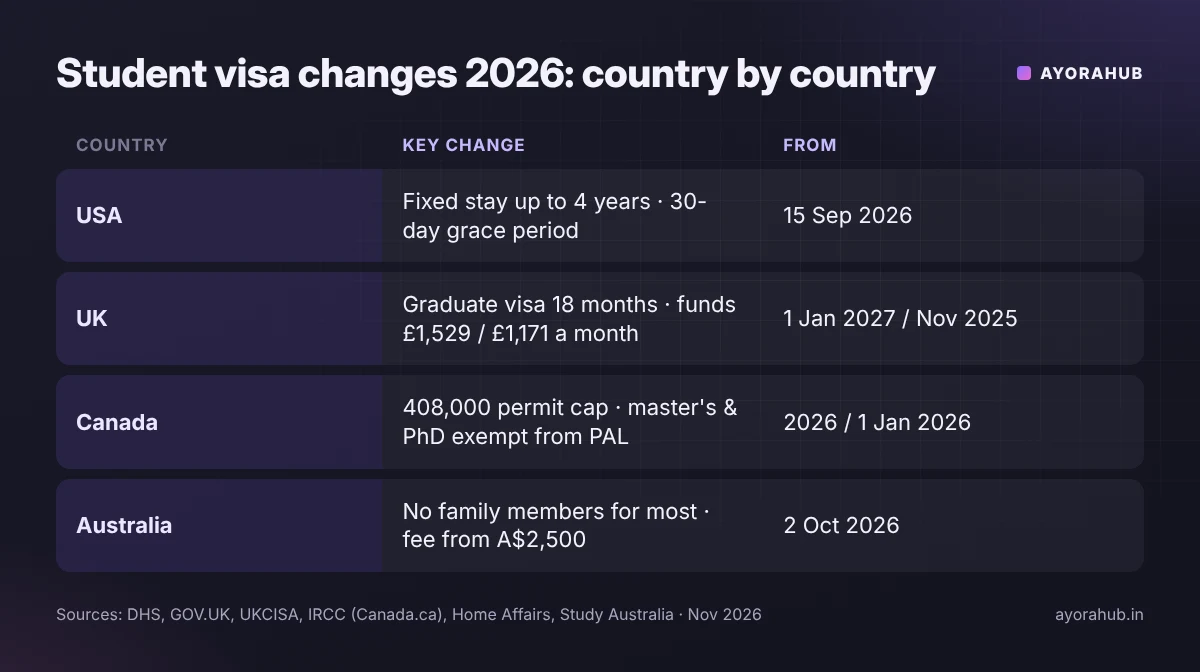
All 8 changes at a glance
| Country | What changed | From | Who is affected |
|---|---|---|---|
| USA | Fixed admission period (I-20 programme length, maximum 4 years) replaces “duration of status” | 15 Sep 2026 | F-1 students (also J and I visa holders) |
| USA | Grace period after programme or OPT cut from 60 to 30 days | 15 Sep 2026 | F-1 students |
| UK | Graduate visa: 18 months instead of 2 years (PhD stays 3 years) | Applications from 1 Jan 2027 | Bachelor’s and master’s graduates |
| UK | Higher maintenance funds: £1,529/month London, £1,171/month elsewhere (up to 9 months) | 11 Nov 2025 | New Student visa applicants |
| Canada | Cap of up to 408,000 study permits: 155,000 new arrivals + 253,000 extensions | 2026 | All study permit applicants |
| Canada | Master’s and PhD students at public institutions exempt from the attestation letter (PAL/TAL); higher proof-of-funds amounts | 1 Jan 2026 / 1 Sep 2026 | Graduate students / all applicants |
| Australia | Family members cannot be included in most Student visa applications; applicants generally must be outside Australia | 2 Oct 2026 | Subclass 500 and 590 applicants |
| Australia | Student visa charge from A$2,500 | In force (as at July 2026) | All Student visa applicants |
United States: the end of “duration of status”
For decades, F-1 students were admitted for “duration of status” (D/S) — as long as they kept studying. A Department of Homeland Security final rule published on 17 July 2026 ended that from 15 September 2026.
What the new rule says
- Fixed admission: you are admitted until the programme end date on your Form I-20, up to a maximum of 4 years, plus 30 days before the programme to arrive and 30 days after it to depart.
- Need more time? You must apply to USCIS for an extension of stay (Form I-539) — for example for a longer PhD, a new programme or, in some cases, practical training.
- Shorter grace period: 30 days to leave after completing your programme or post-completion OPT/STEM OPT, down from 60.
- Work while an extension is pending: if you file on time, you can continue CPT or on-campus work for up to 240 days.
If you are already in the US
Students admitted under D/S can generally stay until the programme end date on their I-20, or the end of authorised OPT/STEM OPT, but not beyond 14 November 2030. DHS also says students who file Form I-765 for post-completion OPT or a STEM OPT extension on time, on or before 18 March 2027, do not need a separate extension-of-stay application. If your case is unusual — a long PhD, a transfer or a change of level — talk to your university’s international student office (DSO) early.
Full costs and admission steps: MS in Computer Science in the USA.
United Kingdom: shorter post-study work, higher funds
Graduate visa: 18 months from 1 January 2027
If you apply for the Graduate visa on or before 31 December 2026, you get 2 years after a bachelor’s or master’s degree. Apply on or after 1 January 2027 and you get 18 months. PhD graduates keep 3 years. The date that counts is the date you submit your application, not when your course started. Details, costs and steps are in our dedicated guide: UK Graduate visa cut to 18 months.
More money to show
For Student visa applications made on or after 11 November 2025, you must show £1,529 per month for courses in London or £1,171 per month outside London, for up to 9 months — that is up to £13,761 in London or £10,539 elsewhere, on top of your course fees. Students also pay the Immigration Health Surcharge of £776 per year.
See also: MSc Computer Science in the UK.
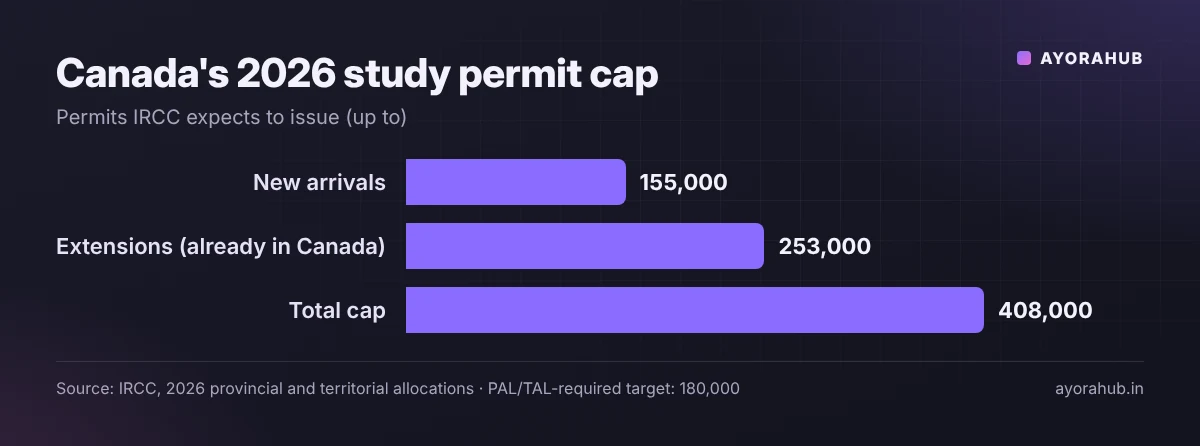
Canada: a tight cap, with relief for master’s and PhD students
The 2026 cap
Immigration, Refugees and Citizenship Canada (IRCC) expects to issue up to 408,000 study permits in 2026: 155,000 to newly arriving students and 253,000 extensions for students already in Canada. Within the total, the issuance target for applicants who need a provincial or territorial attestation letter (PAL/TAL) is 180,000, with Ontario receiving the largest share.
Who needs an attestation letter?
Most college and undergraduate applicants still need a PAL or TAL from the province. But from 1 January 2026, students in master’s or doctoral degree programmes at public institutions do not need one — a real advantage for graduate applicants. A 2026 letter is valid only for the 2026 cap year (until 31 December 2026).
Higher proof of funds
The living-cost amount you must show (in addition to tuition and travel) increased for applications submitted on or after 1 September 2026. IRCC’s example for a student with two family members outside Quebec rose from C$35,040 to C$35,888; for a single student, the amount under the previous table was C$22,895. Use the current table on Canada.ca for your family size — Quebec has its own amounts.
More: Master’s in Computer Science in Canada.
Australia: higher fee, no family members for most students
New application rules from 2 October 2026
- Family members: a partner or dependent children can no longer be included in a Student visa (subclass 500) application unless you are exempt. Exemptions include PhD students, students sponsored by DFAT or Defence, foreign-government scholarship holders, and eligible students from Pacific and ASEAN countries.
- No adding family later: family members cannot be added to a Student visa after it is granted, with no exemptions.
- Apply from outside Australia: applicants generally must apply offshore and be outside Australia when the visa is granted, unless exempt.
- Already hold a visa? Family members who were included in your visa or application before 2 October 2026 can be included again in a further application if you are eligible to apply in Australia. Applications lodged before the change are assessed under the old rules.
An application that includes a family member who is not eligible will be invalid, so check the exemption list before you apply.
Cost and funds
The official Study Australia site lists the Student visa charge as from A$2,500 (correct at July 2026) and says you need evidence of at least A$29,710 for living costs, in addition to tuition and travel.
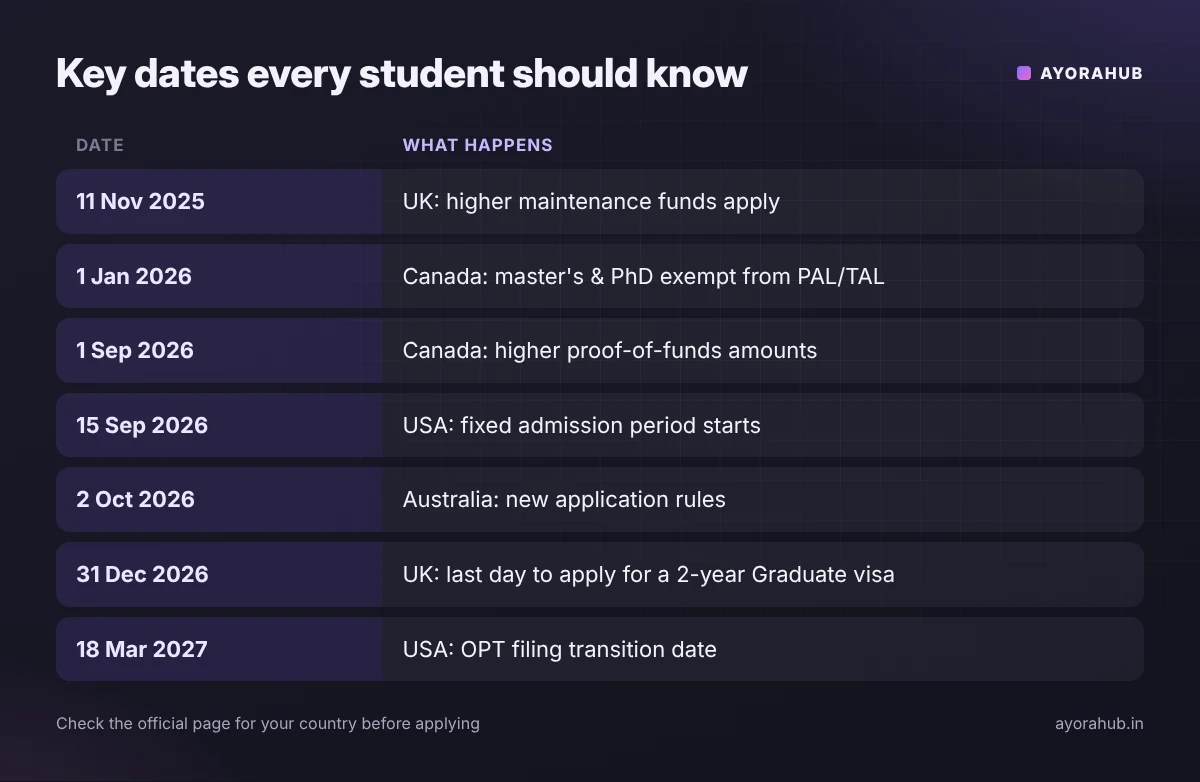
What these changes mean for you
| Your situation | What to do |
|---|---|
| Starting a US degree longer than 4 years (e.g. PhD) | Plan for an extension-of-stay application with USCIS; keep your I-20 dates accurate |
| Finishing a UK degree in late 2026 | Apply for the Graduate visa by 31 December 2026 to keep 2 years |
| Applying to a Canadian college or bachelor’s programme | Secure your attestation letter early — places under the cap are limited |
| Applying for a master’s or PhD in Canada | No attestation letter needed at public institutions; prepare the higher funds amount |
| Planning to bring a spouse or children to Australia | Check whether you are exempt; otherwise family cannot be included |
| Comparing countries for post-study work | Look at Ireland (up to 24 months) and the Netherlands (12-month orientation year) too |
Alternatives worth comparing: Ireland, the Netherlands and Germany, or start with our study CS abroad guide.
Common mistakes to avoid
- Using last year’s funds figures. The UK, Canada and Australia have all raised their amounts.
- Assuming old rules apply because your course started earlier. Most changes depend on your application date.
- Relying on agents or social media. Check the government page linked below for every rule.
- Missing the US 30-day window. Plan your OPT, transfer or departure before your programme ends.
- Including family in an Australian application without checking exemptions — the whole application can be invalid.
Frequently Asked Questions
What are the new US student visa rules in 2026?
From 15 September 2026, F-1 students are admitted for the length of their programme up to 4 years instead of “duration of status”, must apply to USCIS to extend, and have a 30-day grace period instead of 60.
Does the US 4-year limit mean I cannot do a PhD?
No. You can apply for an extension of stay if your programme needs more time.
Is the UK post-study work visa now 18 months?
For bachelor’s and master’s graduates who apply on or after 1 January 2027, yes. Applications made by 31 December 2026 still get 2 years; PhD graduates get 3 years.
How many study permits will Canada issue in 2026?
Up to 408,000: 155,000 for newly arriving students and 253,000 extensions.
Do master’s students need a PAL for Canada?
Not if they are in a master’s or doctoral degree programme at a public institution — they are exempt from 1 January 2026.
Can I bring my spouse on an Australian student visa?
Since 2 October 2026, only if you are exempt (for example PhD students, certain scholarship holders, and eligible Pacific and ASEAN students). Otherwise family members cannot be included or added later.
How much is the Australian student visa fee in 2026?
From A$2,500 per application, according to the official Study Australia website (as at July 2026).
Which country is easiest for international students in 2026?
There is no single answer — it depends on your course level, budget and whether post-study work or bringing family matters most. Compare the rules above with your own plan.
Conclusion
2026 made studying abroad more rule-bound in all four countries: fixed stays in the US, shorter post-study work in the UK, a tight cap in Canada and stricter applications in Australia. None of this closes the door — but dates and documents now matter more than ever. Decide your country, check the official page for each requirement, and apply early.
How we researched this
We used official government sources, plus UKCISA, the UK’s advisory body for international students: the US Department of Homeland Security’s Study in the States pages and the Federal Register; GOV.UK and UKCISA; Immigration, Refugees and Citizenship Canada on Canada.ca; and Australia’s Department of Home Affairs and Study Australia, checked in November 2026. Where an official page did not show a figure clearly (for example the UK Student visa application fee, or Canada’s new single-applicant amount), we link to the page rather than guess. This is general information, not immigration advice.
Sources
- DHS Study in the States – Fixed period of admission final rule: quick facts
- DHS Study in the States – Final rule FAQ
- Federal Register – Fixed time period of admission (17 July 2026)
- GOV.UK – Graduate visa
- UKCISA – Changes to the Student and Graduate rules
- GOV.UK – Immigration Health Surcharge: how much you pay
- GOV.UK – Student visa
- Canada.ca – 2026 allocations under the international student cap
- Canada.ca – Provincial or territorial attestation letter
- Canada.ca – Proof of financial support
- Australian Department of Home Affairs – Changes to Student visa application rules
- Australian Department of Home Affairs – Including or adding family members
- Study Australia – Student visa (subclass 500)