Quick answer (updated November 2026): A master’s in Computer Science in the Netherlands is usually a two-year MSc at a research university. For non-EU students, official institutional fees for 2027/28 are about €22,400 (TU/e), €23,300 (Leiden), €23,430 (UvA) and €26,479 (TU Delft) a year. For your residence permit you must show €1,130.77 a month for living costs (the IND’s 2026 amount for university students). Your university applies for the permit for you. You may work 16 hours a week, or full-time in June, July and August, if your employer has a work permit (TWV). After graduating, the one-year orientation year lets you look for work without a work permit. Employers can then hire you as a highly skilled migrant at a reduced salary of €3,122 gross a month (2026).
The Netherlands combines English-taught programmes, strong technical universities and a large international tech job market. This guide uses only official sources — the Dutch immigration service (IND), Study in NL (the Dutch government’s study portal run by Nuffic), business.gov.nl and the universities’ own pages — so every number can be checked.
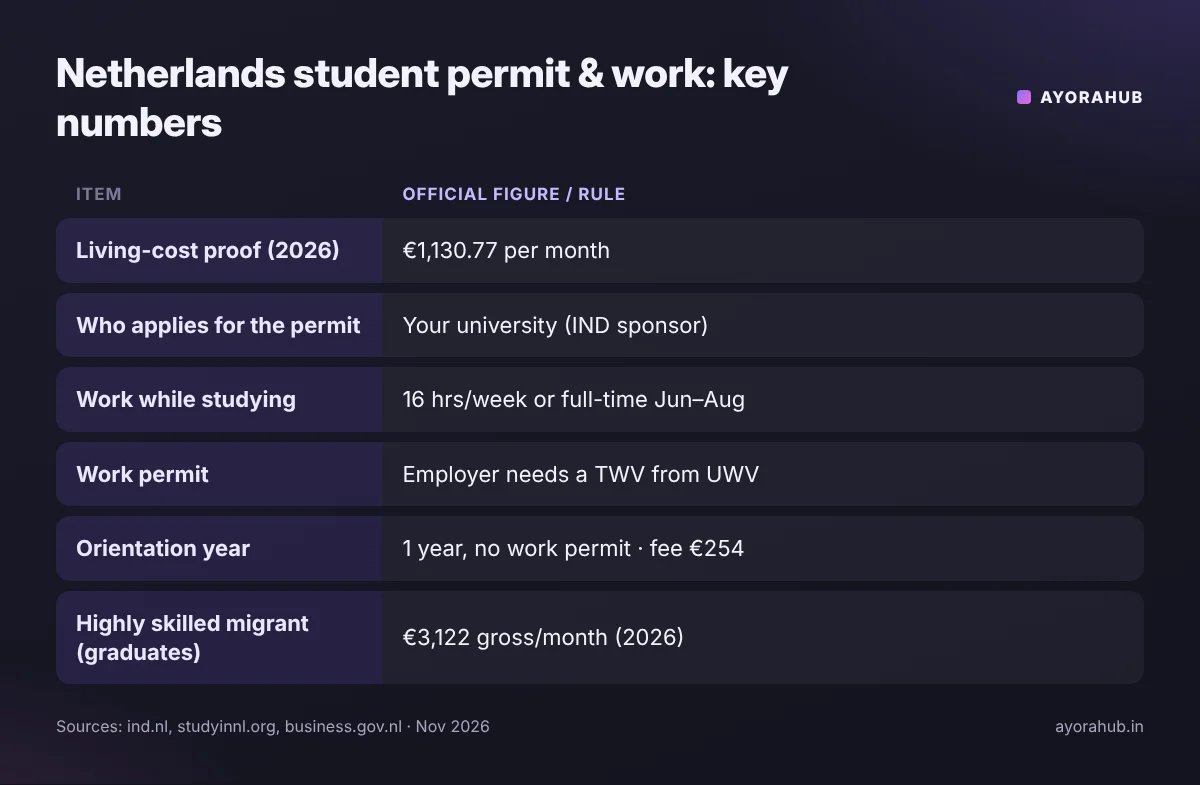
Netherlands for a CS master’s: the key numbers
| Item | Official figure / rule |
|---|---|
| Typical degree | MSc Computer Science, 2 years (120 EC) at research universities |
| Main intake | September (a few universities, such as Twente, also offer February) |
| Tuition, non-EU (2027/28) | About €22,400–€26,479 per year at the universities below |
| Living-cost proof for the permit | €1,130.77 per month (IND, 2026, university/hbo students) |
| Who applies for the permit | Your university (a recognised IND sponsor); you pay the fee through the university |
| Work while studying | Max 16 hrs/week, or full-time in June–August; employer needs a TWV |
| After graduation | Orientation year (1 year, no work permit needed); 2026 application fee €254 |
| Highly skilled migrant salary (recent graduates) | €3,122 gross per month (2026, reduced criterion) |
| English test | Commonly IELTS Academic 6.5 (e.g. Leiden: 6.0 minimum per band) |
How much does a master’s in Computer Science cost in the Netherlands?
Tuition at popular universities
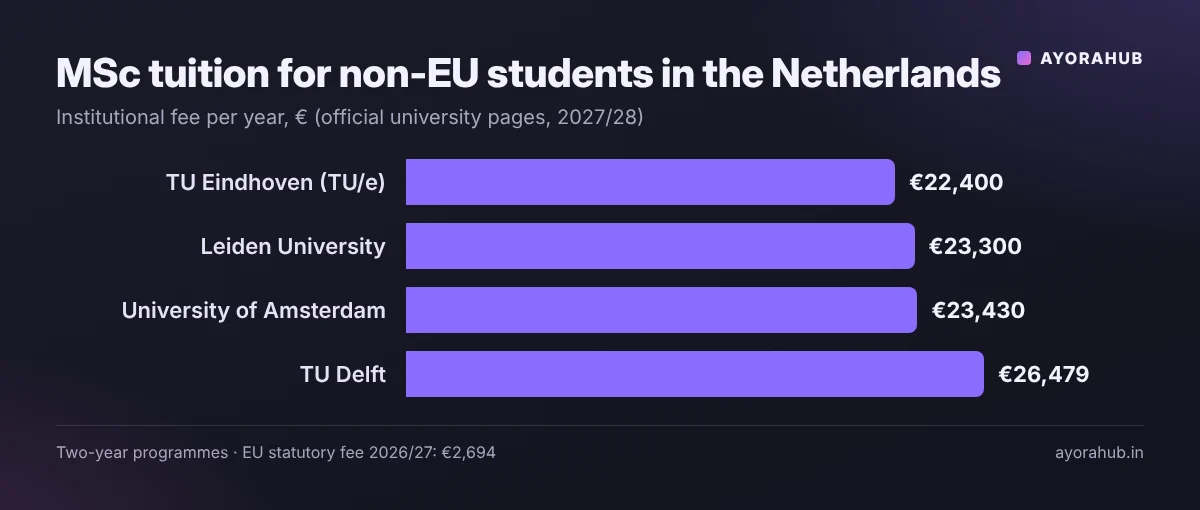
Dutch universities charge non-EU/EEA students an institutional fee, which is much higher than the statutory fee EU students pay (€2,694 in 2026/27), because the government does not fund non-EU places. These are official figures for the 2027/28 academic year — the year you would start if you apply now:
| University | Non-EU institutional fee, MSc (2027/28) |
|---|---|
| Eindhoven University of Technology (TU/e) | €22,400 per year |
| Leiden University – MSc Computer Science | €23,300 per year |
| University of Amsterdam (UvA) – MSc Computer Science (joint with VU) | €23,430 per year |
| Delft University of Technology (TU Delft) | €26,479 per year |
| University of Twente | €18,200 or €21,700 per year (2026/27 rate bands; check which applies to CS) |
Because the MSc lasts two years, multiply by two (and allow for yearly increases). Some universities also ask non-EU students to pay tuition in advance, or a guarantee payment, before they start the residence-permit procedure — check your university’s finance page.
Living costs
The IND requires proof of €1,130.77 a month (2026) — about €13,570 for 12 months — and universities usually ask you to show it for the first year. Study in NL estimates that students spend roughly €1,000–€1,500 a month; Amsterdam, Utrecht and The Hague are the most expensive cities. The Netherlands has a serious housing shortage, so finding a room is often harder than getting admitted.
The full first-year budget
| Item | Approximate amount |
|---|---|
| Tuition (year 1) | €22,400–€26,479 |
| Living costs (12 months) | €13,570 minimum proof; €12,000–€18,000 typical spend |
| Residence permit fee | Paid via the university — see the IND fees page for the current amount |
| Health insurance | Required — foreign cover can be enough while you only study; Dutch basic insurance is compulsory once you work |
| Application fee | Varies (e.g. Twente: €100 for non-Dutch degree holders) |
Step-by-step: how to apply for a CS master’s in the Netherlands
- Shortlist programmes (about 12 months before). Dutch CS master’s degrees are selective and expect a strong bachelor’s in computer science or a closely related field.
- Register in Studielink. Every Dutch programme starts with a Studielink registration, followed by the university’s own application portal.
- Meet the deadline — they are early for non-EU students. Official examples: TU Delft 15 January, UvA 31 January, Leiden 1 April (if you need a visa), Twente and TU/e 1 May for September entry. Check your programme’s page for the exact year.
- Take IELTS or TOEFL early. Most programmes ask for IELTS Academic 6.5; Leiden requires 6.0 in each band and results no older than two years.
- Accept the offer and pay what the university asks. This may include tuition or a deposit, plus proof of the €1,130.77/month living-cost amount.
- Let the university apply for your permit. As a recognised sponsor, your university submits the application to the IND. Indian nationals then collect the entry visa (MVV) from the Dutch embassy or consulate.
- Arrive, register and collect your permit. Register with your city (municipality) to receive your citizen service number (BSN), and collect your residence card.
The student residence permit explained
- Sponsor system: you do not apply on your own — your university does it, and it must report to the IND if you stop studying or make too little progress.
- Funds: the IND’s 2026 required amount for university students is €1,130.77 per month, valid from 1 January to 31 December 2026. It changes every year.
- Fee: paid to the university, which passes it to the IND. It is not refunded if the application is refused.
- Study progress: keep up with your credits — the permit depends on it.
Working during and after your studies
While you study
You may work a maximum of 16 hours a week, or full-time in June, July and August — not both. Your employer must get a work permit (TWV) from UWV for you, and the Dutch Labour Inspectorate checks this. Once you work, Dutch basic health insurance becomes compulsory.
After you graduate: the orientation year
The orientation year for highly educated persons is a one-year residence permit to look for a job. During it you may work without a work permit. You can apply within three years of completing your studies; the IND fee for applications in 2026 is €254.
Moving to a highly skilled migrant permit
Employers recognised by the IND can hire you as a highly skilled migrant. Recent graduates (during the orientation year or within three years of graduating) qualify for a reduced salary criterion of €3,122 gross a month in 2026, excluding holiday pay. The normal criterion is much higher (€5,942 for those aged 30 and over).
Advantages and disadvantages
| Advantages | Disadvantages |
|---|---|
| Highly ranked technical universities (TU Delft, TU/e, UvA) | Two-year MSc — higher total tuition than one-year degrees |
| Fully English-taught programmes | Severe student housing shortage |
| One-year orientation year with free work rights | Early application deadlines for non-EU students |
| Low reduced salary threshold for graduates (€3,122/month) | Part-time work limited to 16 hours/week and needs a TWV |
Common mistakes (and how to avoid them)
- Missing the non-EU deadline. It can be months earlier than the EU deadline (for example, January instead of May).
- Arriving without housing. Start searching the moment you are admitted; use university housing offers where available.
- Working without a TWV. Your employer must have one; working illegally can cost you your permit.
- Using last year’s funds amount. The IND amount changes every year — use the current figure.
- Ignoring study progress. Your university must report insufficient progress to the IND.
Safety, privacy and limitations
- Beware of rental scams. Never pay for a room you cannot view or verify.
- Only official channels. Your university handles the permit — no agent can speed up or guarantee it.
- Protect your BSN and passport details. Share them only with official bodies, your employer and your university.
- Rules change yearly. Fees, required amounts and salary criteria are updated each January (and some mid-year).
Beginner tips
- Read each programme’s admission requirements carefully — Dutch CS master’s degrees check your bachelor’s courses closely.
- Plan a two-year budget, not one.
- Use the Study in NL website for scholarships and practical information.
Advanced tips
- Apply in the first round where possible; some universities rank applications after the deadline.
- Look for scholarships with early deadlines (for example, TU/e’s Scholarship for Excellence closes 1 January 2027).
- Do your thesis or an internship with a company — it is a strong route to a highly skilled migrant job offer.
Frequently Asked Questions
How much does a master’s in Computer Science cost in the Netherlands?
For non-EU students, official 2027/28 institutional fees are about €22,400–€26,479 a year at TU/e, Leiden, UvA and TU Delft, for a two-year programme, plus living costs.
How much money do I need to show for a Dutch student residence permit?
The IND’s 2026 required amount for university students is €1,130.77 per month, usually shown for the first year (about €13,570).
Can international students work in the Netherlands?
Yes, up to 16 hours a week or full-time in June, July and August, as long as the employer has a work permit (TWV) for you.
What is the orientation year?
A one-year residence permit after graduation to find a job, during which you can work without a work permit. You must apply within three years of graduating.
What salary do I need for a highly skilled migrant job after graduation?
Recent graduates qualify for the reduced criterion of €3,122 gross per month in 2026.
Do I need IELTS for the Netherlands?
Most English-taught programmes require IELTS Academic (commonly 6.5) or an equivalent test such as TOEFL.
Is the Netherlands better than Germany for a CS master’s?
Germany’s public universities charge little or no tuition, while the Netherlands charges non-EU students over €22,000 a year but teaches all programmes in English and offers a simple orientation year. See our Germany guide.
Conclusion: your next steps
The Netherlands is a strong choice if you want a rigorous, English-taught CS master’s and a clear route into European tech jobs. Check deadlines now — for September 2027 they start as early as January 2027 — prepare IELTS and your funds, and begin your housing search early. Compare destinations in our study CS abroad guide, including Ireland, the UK, the USA and Canada.
How we researched this
We used only official sources: the Dutch Immigration and Naturalisation Service (IND), Study in NL (the official Dutch study portal run by Nuffic), the Dutch government’s business.gov.nl, and official tuition, admission and deadline pages of Dutch universities, checked in November 2026. Tuition is shown for 2027/28 where published. This is general information, not immigration advice — confirm each figure on the official page before you apply.
Sources
- IND – Fees and required amounts for 2026
- IND – Required amounts (income requirements)
- IND – Fees: costs of an application
- IND – International students and the IND
- business.gov.nl – Residence permit for orientation year
- Study in NL – Working after your studies
- Study in NL – Cost of living in the Netherlands
- Study in NL – Health insurance
- TU Delft – Tuition fee & finances
- TU Delft – MSc Computer Science: non-EU applicants
- TU/e – Tuition fee
- Leiden University – MSc Computer Science tuition fees
- University of Amsterdam – Tuition fees
- University of Twente – Computer Science admission (international)