

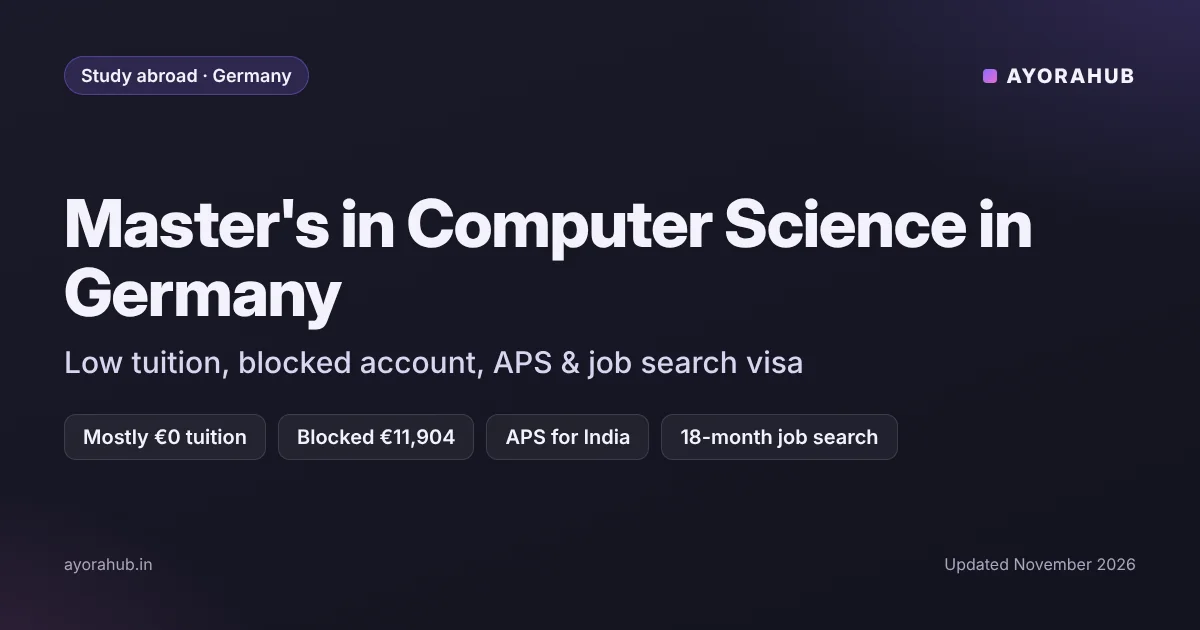
Quick answer (updated November 2026): Germany is one of the most affordable places to study computer science: most public universities charge no tuition to international students — you pay a semester contribution of roughly €100–400. Exceptions exist: Baden-Württemberg charges €1,500 per semester, TUM charges €2,000–6,000 per semester for some programs, and FAU plans fees for new non-EU students from summer 2027 (as reported). For the visa you need a blocked account of €11,904 per year and, if you studied in India, an APS certificate. After graduating, you can get a residence permit of up to 18 months to look for a job.
Master’s in Computer Science in Germany: key facts
| Item | Details (2026–27) |
|---|---|
| Duration | Usually 2 years (4 semesters) |
| Tuition at most public universities | €0 + semester contribution (~€100–400) |
| Exceptions | Baden-Württemberg €1,500/semester; TUM €2,000–6,000/semester for some programs; FAU from summer 2027 (as reported) |
| Intakes | Winter semester (October) — main; summer semester (April) for some programs |
| Typical deadlines | Often 15 July for winter and 15 January for summer (many universities/uni-assist) — check each program |
| Language | Many English-taught master’s; German-taught programs need German proof |
| Blocked account | €11,904/year (€992/month) |
| APS (Indian applicants) | Required; fee reported around ₹18,000 |
| Work during studies | 140 full or 280 half days per year; max 20 hours/week during lectures |
| Work after studies | Up to 18 months residence permit to find a job |
Is studying in Germany really free?
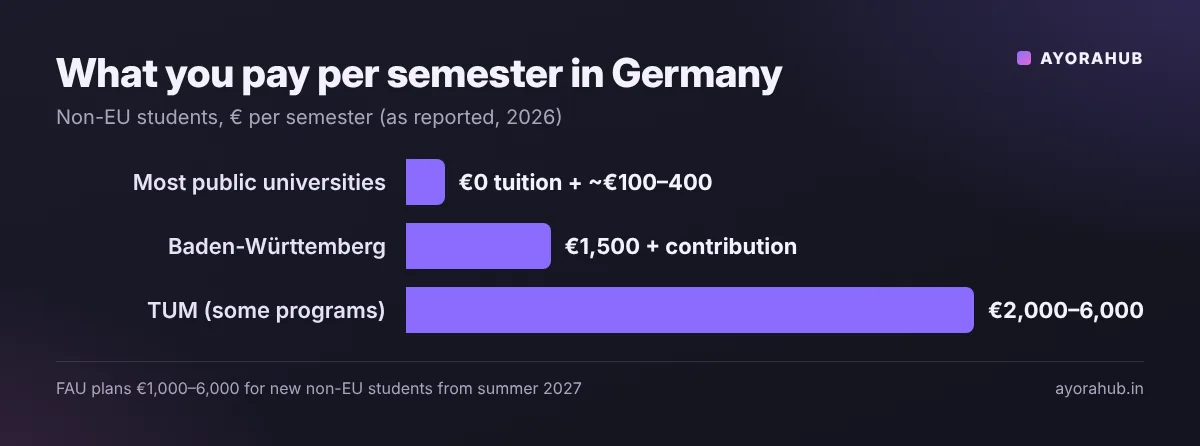
Mostly yes at public universities, with important exceptions:
| Where | What international (non-EU) students pay per semester (as reported) |
|---|---|
| Most public universities (e.g. RWTH Aachen) | No tuition; semester contribution ~€100–400 (RWTH ~€300) |
| Baden-Württemberg (e.g. KIT, Stuttgart, Heidelberg) | €1,500 tuition + semester contribution |
| TUM (Technical University of Munich) | €2,000–6,000 depending on program |
| FAU Erlangen-Nürnberg | €1,000–6,000 for new non-EU students from summer semester 2027 |
| Private universities | Tuition charged — often much higher |
The semester contribution often includes a public-transport ticket, which saves money on travel.
Admission requirements
- Bachelor’s degree in CS or a closely related field; German universities check course content (modules) closely.
- Good grades — many programs list a minimum grade converted to the German scale.
- English proof (IELTS/TOEFL) for English-taught programs, or German proof (e.g. TestDaF/DSH) for German-taught ones.
- Many universities accept applications through uni-assist; others take applications directly.
- APS certificate for applicants with Indian academic qualifications applying for a German student visa.
Visa checklist for Indian students
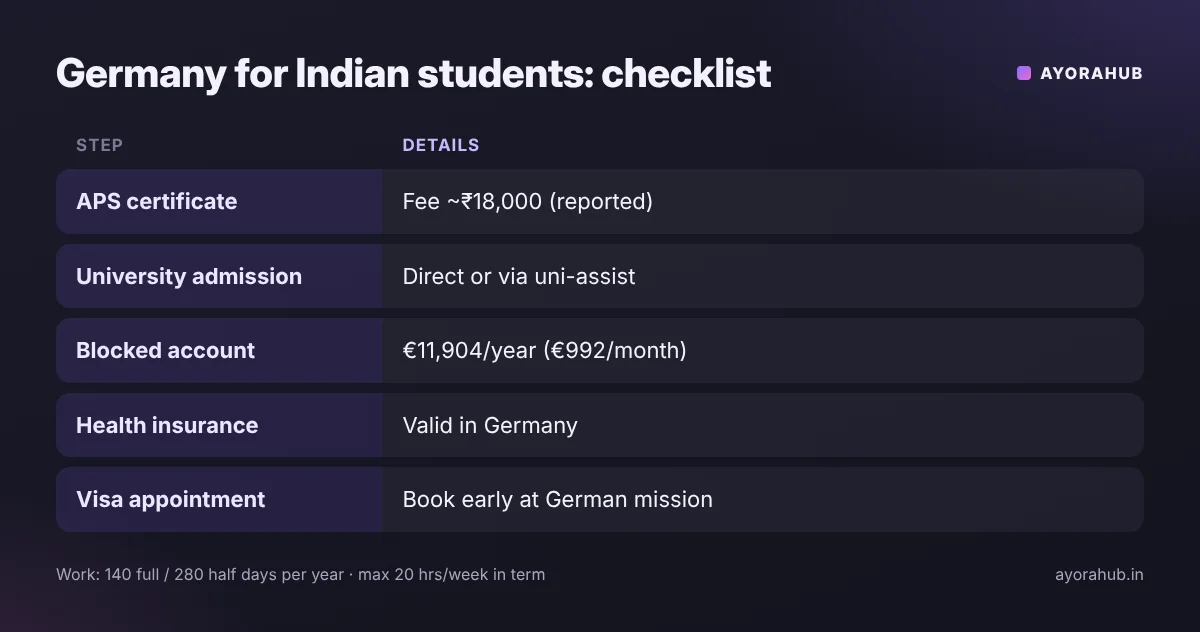
- APS certificate — apply early; the fee is reported around ₹18,000 (one source cites ₹18,500). A separate dMAT test (€150) may apply for some applicants.
- Admission letter from a German university.
- Blocked account with €11,904 (released at €992 per month).
- Health insurance valid in Germany.
- Book your visa appointment with the German mission in India early — waiting times can be long.
Working during and after your studies
- During studies: 140 full days or 280 half days per year (since March 2024), with a 20-hour weekly limit during lecture periods. University student-assistant jobs and mandatory internships do not count toward the annual cap.
- After graduation: a residence permit of up to 18 months to look for work related to your degree. Once employed, you can move to an EU Blue Card or other work permit.
Is a master’s in CS in Germany worth it?
Pros: very low or no tuition, strong technical universities, 18-month job-search permit, and a large engineering job market. Cons: learning German helps a lot for jobs and daily life, admissions check course content strictly, and visa appointments can take time. Compare with the USA, the UK and Canada in our study computer science abroad guide.
Frequently Asked Questions
Is a master’s in Computer Science free in Germany?
At most public universities, yes — you pay only a semester contribution of about €100–400. Baden-Württemberg, TUM and (from 2027) FAU charge fees to many non-EU students.
How much is the German blocked account in 2026?
€11,904 per year (€992 per month) for student visa applicants.
Is APS mandatory for Indian students?
Yes, for applicants with Indian academic qualifications applying for a German student visa. The fee is reported at around ₹18,000.
Can international students work in Germany?
Yes — 140 full or 280 half days per year, with a maximum of 20 hours per week during lecture periods.
Can I stay in Germany after my master’s?
Yes. Graduates can get a residence permit of up to 18 months to look for a job related to their degree.
How we researched this
We compiled tuition rules from state-by-state trackers and university pages, blocked-account amounts from 2026 guides citing the Residence Act, work rules from German university international offices, and APS information from India-focused guides. Sources differed on some details (for example the APS fee and which states charge tuition), which we flag. This is general information — confirm on DAAD, APS India, the German Missions in India and each university’s website.
Sources
- Germany tuition fees 2026: state-by-state tracker
- Mastersportal – Germany university fees and living costs 2026
- Is university free in Germany? Fees for non-EU 2026/27
- Germany blocked account 2026: €11,904
- Goethe University Frankfurt – Work rules for international students
- FAU – Work rules for non-EU students
- Collegedunia – APS certificate for Germany 2026
- APS certificate Germany 2026: rules, fees and dMAT
Comments are closed.