

Quick answer (updated November 2026): The most popular countries for studying computer science and technology abroad are the USA, UK, Canada and Germany. The USA offers the longest post-study work period for STEM graduates (up to 36 months of OPT) but the highest fees; the UK has one-year master’s degrees but its Graduate Route shrinks to 18 months from January 2027; Canada offers up to three years of post-graduation work for master’s graduates but now caps study permits; and Germany charges little or no tuition at most public universities. Rules changed a lot in 2025–2026, so always confirm on the official government and university pages linked in each guide.
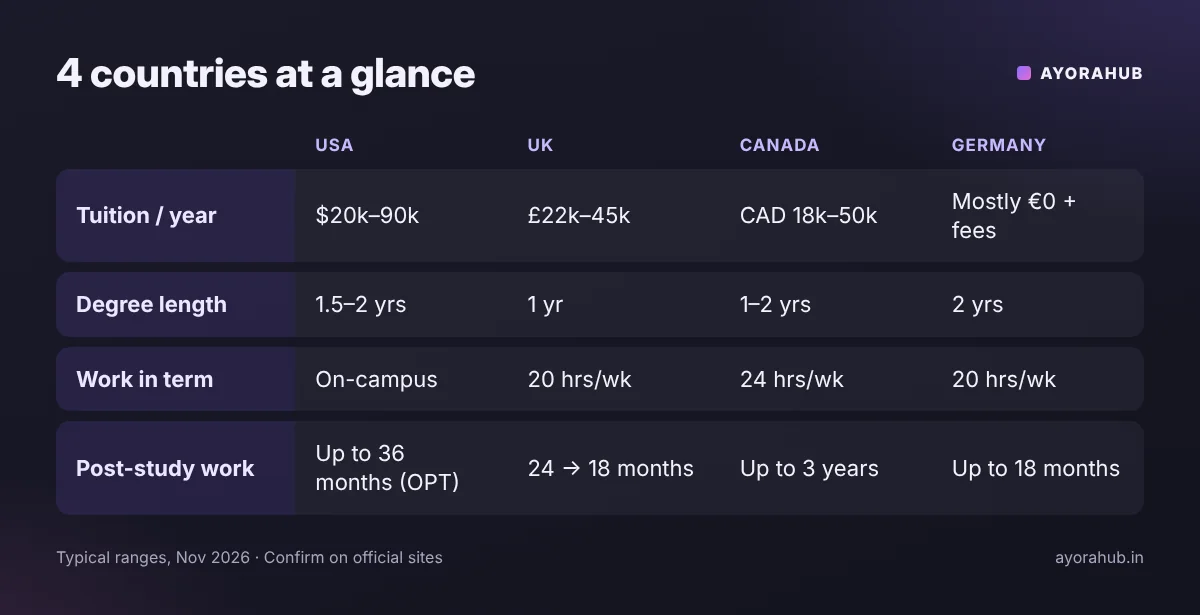
Country comparison: studying computer science abroad (2027 intake)
| USA | UK | Canada | Germany | |
|---|---|---|---|---|
| Typical master’s length | 1.5–2 years | 1 year | 1–2 years | 2 years |
| Typical annual tuition (international, CS master’s) | ~$20,000–$90,000 (public lower, private higher) | ~£22,000–£45,000 | ~CAD 18,000–50,000 | Mostly €0 + semester contribution (~€100–400); exceptions apply |
| Proof of funds / living cost rule | Show funds for first year (per I-20) | £1,529/month in London, £1,171/month elsewhere (as reported) | CAD 22,895/year (reported; one source says CAD 23,448 from Sept 2026) | Blocked account €11,904/year |
| Main visa costs | $185 visa + $350 SEVIS (+ $250 integrity fee where collected) | £558 visa + £776/year health surcharge | Study permit fee + biometrics (check IRCC) | National visa fee + APS (Indian applicants) |
| Work while studying | On-campus only (limited) | Up to 20 hrs/week in term (degree level) | Up to 24 hrs/week off-campus in term | 140 full / 280 half days per year; max 20 hrs/week in term |
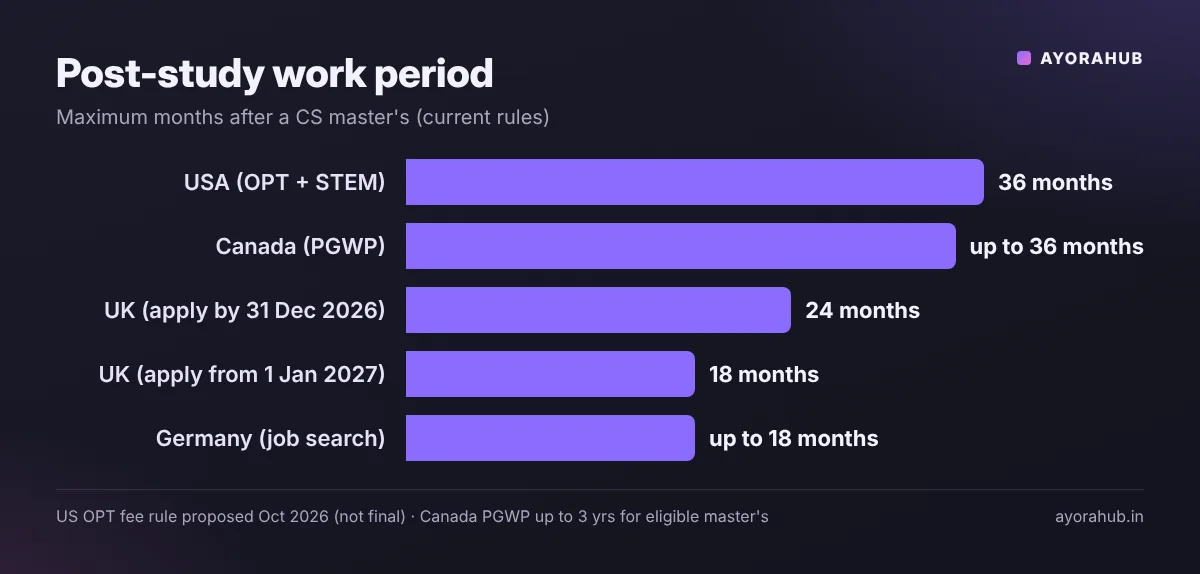
| Post-study work | OPT 12 months + 24-month STEM extension | Graduate Route: 2 years (apply by 31 Dec 2026), 18 months from 1 Jan 2027 | PGWP up to 3 years for eligible master’s | Up to 18 months to find a job |
| Main intake | Fall (Aug/Sep) | September (some January) | September (some January) | Winter semester (October); some April |
Figures are typical ranges compiled from official pages and reports in 2026; individual universities and visa rules vary. See each country guide for details and sources.
Country guides
- MS in Computer Science in the USA — fees, admission, F-1 visa, OPT and the 2026 changes.
- MSc Computer Science in the UK — one-year degrees, visa costs and the Graduate Route change.
- Master’s in Computer Science in Canada — study permit cap, proof of funds and PGWP.
- Master’s in Computer Science in Germany — low tuition, blocked account and APS.
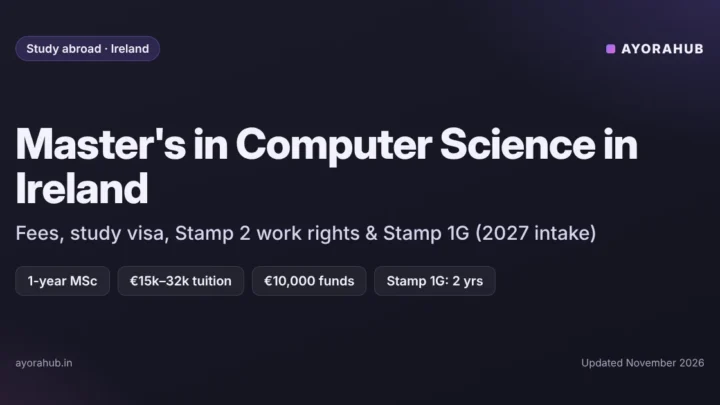
- Master’s in Computer Science in Ireland — one-year MSc, €10,000 funds rule, Stamp 2 work hours and Stamp 1G stay-back.
- Master’s in Computer Science in the Netherlands — tuition, IND funds amount, 16-hour work rule and the orientation year.
What changed in 2025–2026 (important)
- USA: a $250 “visa integrity fee” was created by law in July 2025, though collection has been uneven. In October 2026 DHS proposed large new OPT fees ($70,000 for initial OPT and $30,000 for later periods including the STEM extension) — this is a proposal, not a final rule.
- UK: the student visa fee rose to £558 from 8 April 2026, and the Graduate Route falls from two years to 18 months for applications made from 1 January 2027.
- Canada: IRCC set a 2026 study permit cap (about 309,670 application spaces, as reported). Most master’s and PhD applicants are exempt from the provincial attestation letter requirement.
- Germany: most public universities remain tuition-free for international students, but some states and universities charge fees (Baden-Württemberg, TUM, and FAU from summer 2027, as reported).
Which country is best for you?
| Your priority | Best fit | Why |
|---|---|---|
| Lowest tuition | Germany | Most public universities charge no tuition |
| Longest post-study work (STEM) | USA | OPT + STEM extension up to 36 months (watch the proposed fee rule) |
| Shortest degree | UK | One-year master’s |
| Work rights + immigration pathways | Canada | PGWP up to 3 years for eligible master’s graduates |
| Top tech industry exposure | USA | Largest tech job market |
Step-by-step: how to apply abroad for computer science
- 12–18 months before: shortlist countries and universities; check entry requirements and deadlines.
- 10–12 months before: take English tests (IELTS/TOEFL/PTE) and, where required, the GRE.
- 8–10 months before: prepare your statement of purpose, CV and recommendation letters; apply.
- 4–6 months before: accept an offer, arrange funds and any required deposits or blocked account.
- 3–4 months before: apply for the student visa (and APS first, for Indian applicants to Germany).
- 1–2 months before: book accommodation, travel and health insurance.
Useful AI tools for applying abroad
AI assistants can help you shortlist universities, improve your statement of purpose and prepare for interviews — but never submit AI-written essays as your own, and always verify facts on official pages. See best AI tools for students and Perplexity vs ChatGPT for research.
Frequently Asked Questions
Which country is cheapest for a master’s in computer science?
Germany, because most public universities charge no tuition to international students — you mainly pay a semester contribution and living costs. Some states and universities do charge fees.
Which country gives the longest work visa after studies?
For STEM graduates, the USA (up to 36 months of OPT including the STEM extension) and Canada (PGWP up to 3 years for eligible master’s graduates).
Is the UK Graduate Route being reduced?
Yes. It is two years if you apply by 31 December 2026 and 18 months if you apply from 1 January 2027.
Do I need the GRE?
Many US programs have made the GRE optional, while UK, Canadian and German programs usually do not require it. Check each program.
When should I start applying?
Ideally 12–18 months before your intended start date.
How we researched this
We compiled visa, fee and work-rights rules from government-linked guidance and 2026 reports, and tuition figures from official university fee pages where available (for example UCL, Purdue and Illinois) plus education aggregators. Immigration rules changed frequently in 2025–2026 and several sources disagreed; where they did, we show both figures or flag the uncertainty. This guide is general information, not immigration advice — confirm everything on the official government and university websites before applying. We update this page as rules change.
Sources
- Global Immigration Blog – DHS proposes new OPT fees (Oct 2026)
- US $250 visa integrity fee for students
- Prodigy Finance – UK student visa 2026 fees and Graduate Route changes
- VisaMet – UK student visa cost 2026
- Study permit Canada 2026: cap, PAL and proof of funds
- GoFar – Canada study permit 2026
- Germany blocked account 2026: €11,904
- Germany tuition fees 2026: state-by-state tracker
- Goethe University Frankfurt – Work rules for international students
- Wikipedia – Indian students abroad

Comments are closed.