

Quick answer (updated November 2026): An MS in Computer Science in the USA usually takes 1.5–2 years and costs roughly $20,000–$90,000 a year in tuition for international students — public universities such as Purdue (~$29,000) and Illinois (~$40,000) at the lower-middle, private schools such as MIT (~$60,000+) at the top (as reported for 2026). You need an F-1 visa ($185 application fee + $350 SEVIS fee, plus a $250 visa integrity fee where it is collected). After graduating, CS students can usually work on OPT for 12 months plus a 24-month STEM extension — but a new fee on OPT was proposed in October 2026 and is not yet final.
MS in Computer Science in the USA: key facts
| Item | Details (2026–27) |
|---|---|
| Duration | Usually 1.5–2 years (some 1-year programs) |
| Annual tuition (international) | ~$20,000–$90,000; public lower-middle, private higher |
| Main intake | Fall (August/September); some programs offer Spring (January) |
| Typical deadlines (Fall) | Most programs: December–February (check each program) |
| Tests | TOEFL/IELTS/Duolingo for English; GRE optional at many programs |
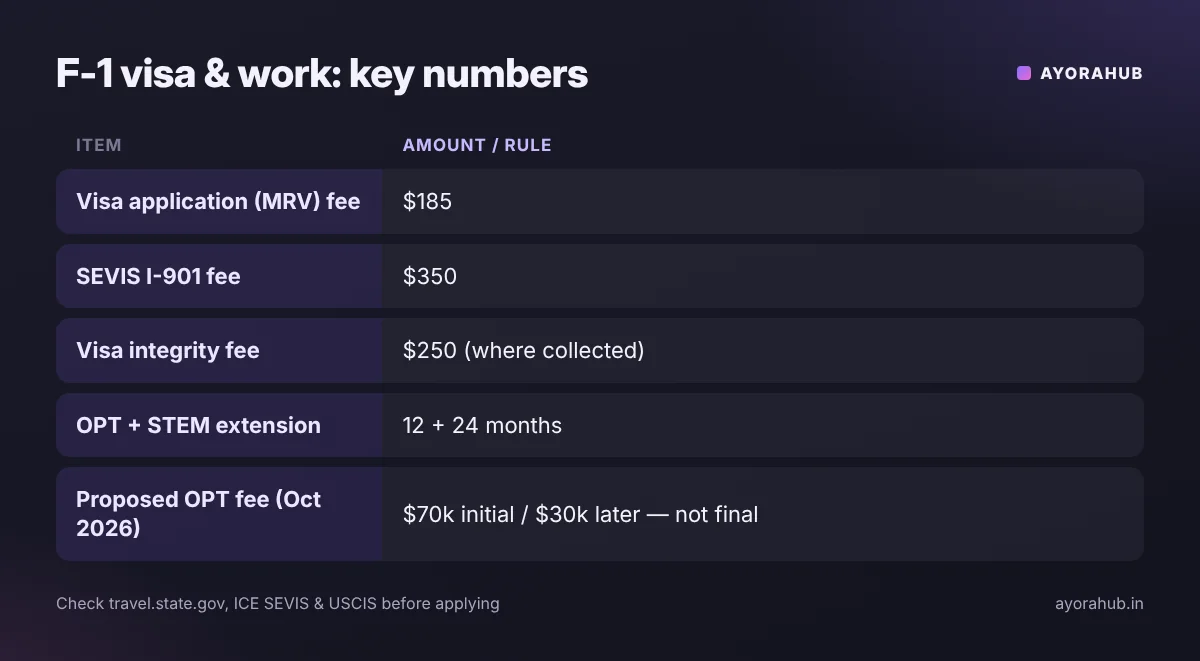
| Visa | F-1: $185 visa fee + $350 SEVIS I-901 fee (+ $250 integrity fee where collected) |
| Work during studies | On-campus jobs (limited hours during term); CPT if your program allows |
| Work after studies | OPT 12 months + STEM OPT extension 24 months for eligible STEM degrees |
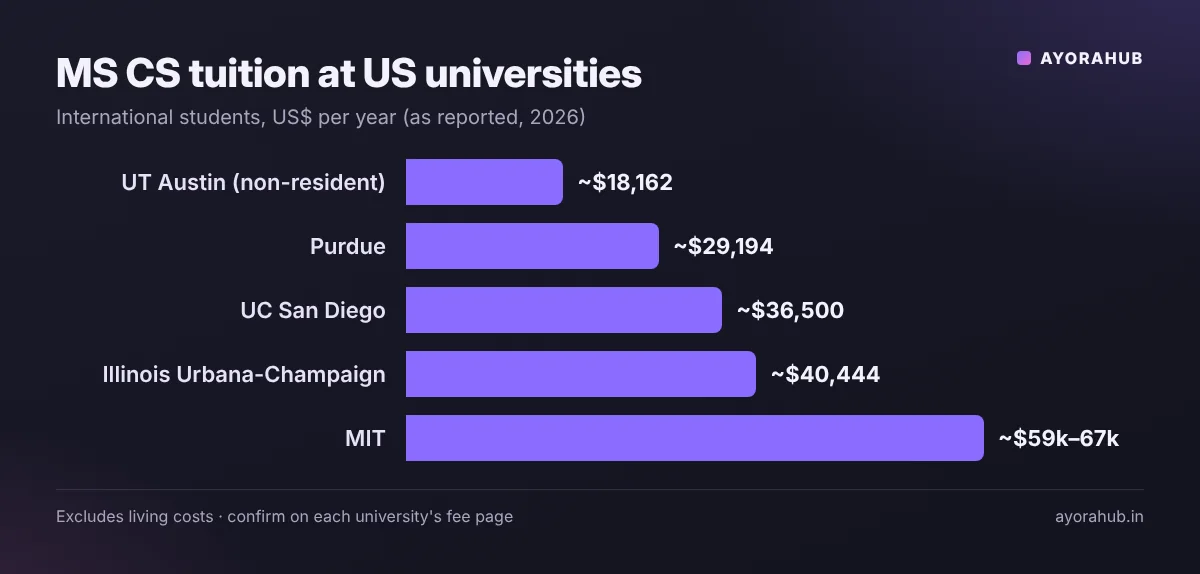
Tuition fees at popular US universities (international, per year)
| University | Type | Reported annual tuition |
|---|---|---|
| UT Austin | Public | ~$18,162 (non-resident, as reported) |
| Purdue University | Public | ~$29,194 |
| UC San Diego | Public | ~$36,500 (tuition and fees, non-resident) |
| University of Illinois Urbana-Champaign | Public | ~$40,444 |
| MIT | Private | ~$59,000–$66,720 |
Low-cost alternative: Georgia Tech’s online OMSCS is reported at around $7,000 for the whole degree, but it is an online program and does not come with an F-1 visa.
Total budget: estimates for two years including living costs range from about ₹60–80 lakh at budget public universities to ₹1.4–1.8 crore at private universities in expensive cities (as reported for Indian students).
Admission requirements
- Bachelor’s degree in computer science, IT or a related field (some programs accept other STEM backgrounds with prerequisites).
- Academic transcripts and, for Indian students, a strong CGPA/percentage; check whether the program needs a credential evaluation.
- English test: TOEFL, IELTS or (at some universities) Duolingo English Test.
- GRE: optional or not required at many programs since 2020; some top programs still recommend it.
- Statement of purpose, CV/résumé and usually 2–3 letters of recommendation.
- Proof of funds for the first year, which the university uses to issue your I-20.
F-1 student visa: costs and process
- Get admitted and receive your Form I-20 from the university.
- Pay the SEVIS I-901 fee ($350).
- Complete the DS-160 form and pay the visa application (MRV) fee ($185).
- Book and attend the visa interview at a US embassy or consulate.
- If approved, a $250 visa integrity fee may be charged at issuance — it was created by law in July 2025, but reports say collection has been uneven, so check the current instructions for your consulate.
Reports also describe stricter vetting in 2026, including social-media checks. Prepare to explain your study plans and funding clearly.
Working in the USA after your MS: OPT and STEM OPT
- OPT: up to 12 months of work in your field after graduation.
- STEM OPT extension: an additional 24 months for eligible STEM degrees such as computer science — up to 36 months in total.
- Proposed OPT fees (not final): on 8 October 2026, DHS proposed a $70,000 fee for an initial OPT grant and $30,000 for later OPT periods, including the STEM extension, to be paid by the school. Public comments close on 9 November 2026. Current OPT rules stay in place unless a final rule takes effect.
- H-1B: a September 2025 proclamation added a $100,000 payment for many new H-1B petitions; students changing status inside the US were reported to be exempt if the change of status is approved. Its status in late 2026 is uncertain — check USCIS for the latest.
Is an MS in CS in the USA worth it in 2027?
Pros: the world’s largest tech job market, strong universities, and up to three years of post-study work under current rules. Cons: high cost and significant policy uncertainty around OPT and H-1B. If cost or uncertainty is a concern, compare with Germany (low tuition) and Canada (PGWP up to 3 years). See all options in our study computer science abroad guide.
Frequently Asked Questions
How much does an MS in Computer Science in the USA cost?
Tuition is roughly $20,000–$90,000 per year for international students, depending on the university. Including living costs, Indian students should budget roughly ₹60 lakh to ₹1.8 crore for two years (as reported).
Is the GRE required for MS CS in the USA?
Many programs have made it optional, but some top programs still recommend it. Check each program’s admissions page.
What is the F-1 visa fee?
$185 for the visa application plus $350 for SEVIS. A $250 visa integrity fee may also apply at issuance.
Can I work in the USA after an MS in Computer Science?
Yes. Under current rules, OPT gives 12 months, and the STEM OPT extension adds 24 months for eligible degrees. New OPT fees have been proposed but are not final.
When are MS CS application deadlines in the USA?
For Fall intake, most deadlines fall between December and February. Some programs have earlier deadlines for scholarships.
How we researched this
Tuition examples come from 2026 reports citing university fee pages; visa and work rules come from US government-linked reporting and immigration law firm analyses published in 2026. Several rules are proposals or under litigation, which we label clearly. This is general information, not legal advice — confirm on travel.state.gov, ICE SEVIS and USCIS, and on each university’s official fee page.
Sources
- Nomad Credit – MS in Computer Science in USA
- Leap Scholar – MS in CS in USA: colleges and fees
- GradPilot – UC San Diego MS CS costs
- Collegedunia – Cost of MS in USA for Indian students
- VisaVerge – Cheapest MS CS programs (2026)
- Global Immigration Blog – DHS proposes new OPT fees
- IDP – US student visa rules 2026
- US visa integrity fee 2026 for F-1 students
- National Law Review – $100,000 H-1B fee: who is exempt
Comments are closed.