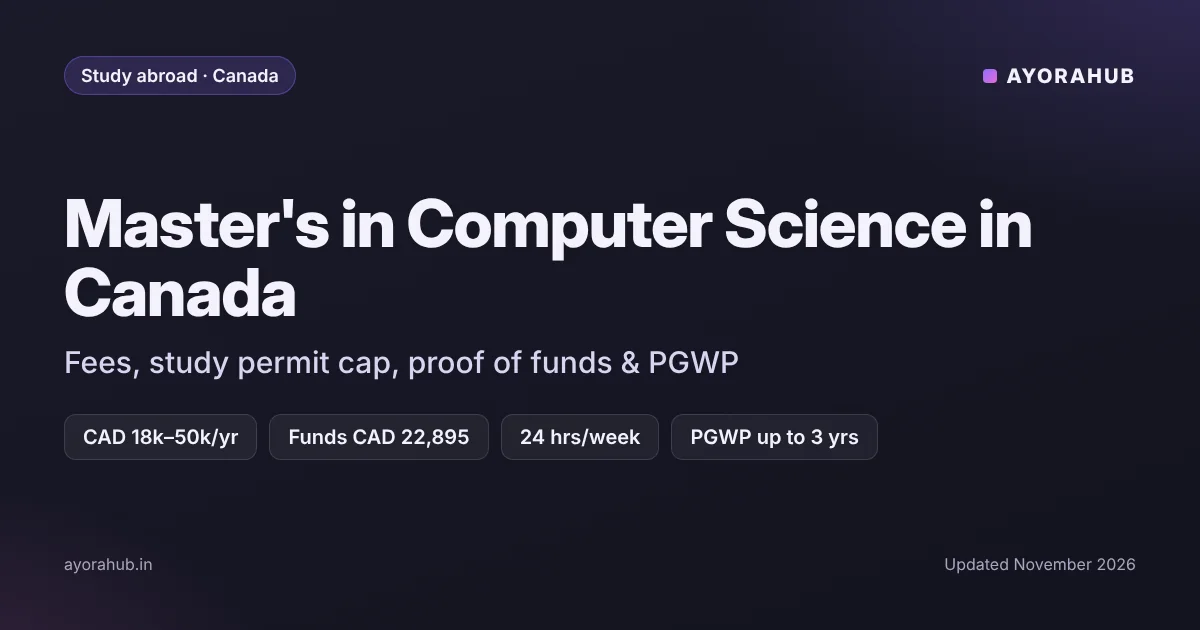
Quick answer (updated November 2026): A master’s in Computer Science in Canada usually takes 1–2 years, with international tuition roughly CAD 18,000–50,000 a year — Statistics Canada’s average international graduate tuition is about CAD 24,028, while the University of Toronto’s graduate international tuition is reported from about CAD 44,852. You must show living funds of CAD 22,895 a year (one source reports CAD 23,448 for applications from 1 September 2026). Canada capped study permits for 2026, but most master’s applicants are exempt from the provincial attestation letter. Eligible master’s graduates can get a PGWP of up to 3 years.
Master’s in Computer Science in Canada: key facts
| Item | Details (2026–27) |
|---|---|
| Duration | 1–2 years (course-based or thesis-based) |
| Tuition (international) | ~CAD 18,000–50,000 per year; national graduate average ~CAD 24,028 |
| Intakes | September (main); some programs January or May |
| Typical deadlines | December–February for September intake (varies by university) |
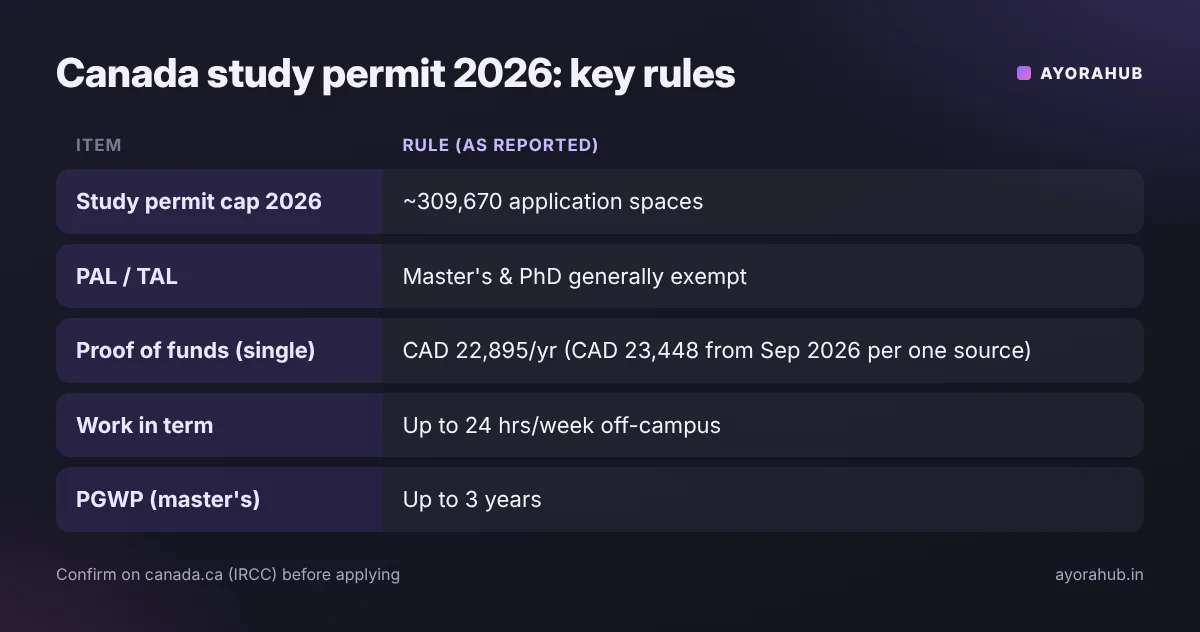
| Proof of funds | CAD 22,895/year for a single applicant outside Quebec (reported; possibly CAD 23,448 from Sept 2026) + first-year tuition + travel |
| Study permit cap | 2026 cap set (~309,670 application spaces, as reported); master’s/PhD generally exempt from PAL |
| Work during studies | Up to 24 hours/week off-campus in term; full-time in scheduled breaks |
| Work after studies | PGWP up to 3 years for eligible master’s graduates |
Tuition: what to expect
| Option | Reported international tuition |
|---|---|
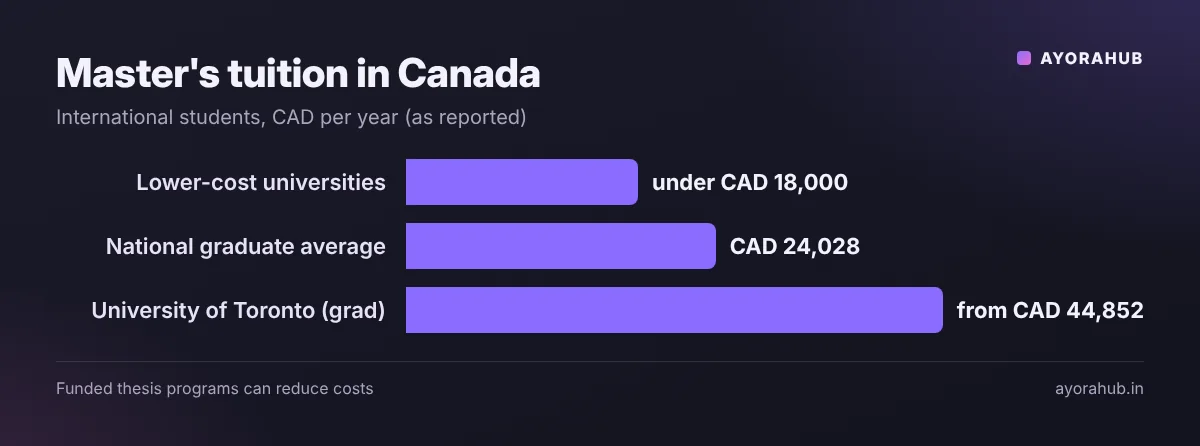
| Lower-cost universities (e.g. in Manitoba, Saskatchewan, Newfoundland) | Often under CAD 18,000/year |
| National average (graduate, international) | ~CAD 24,028/year (Statistics Canada, as cited) |
| University of Toronto (graduate, international) | ~CAD 44,852–50,000/year |
Thesis-based research master’s programs often come with funding (teaching or research assistantships) that can reduce costs significantly — ask each department.
Admission requirements
- Four-year bachelor’s degree in CS or a related field with a strong GPA (often B or about 75%+; competitive programs higher).
- English test: IELTS, TOEFL or other accepted tests (CELPIP/PTE accepted by some).
- Statement of purpose, CV and usually two or three references.
- For research (thesis) programs: contacting a potential supervisor before applying helps.
- GRE: usually not required, though a few programs consider it.
Study permit in 2026: what changed
- Cap: IRCC set a 2026 study permit cap (about 309,670 application spaces, as reported).
- PAL/TAL: most undergraduate and college applicants need a Provincial or Territorial Attestation Letter; master’s and PhD applicants are generally exempt.
- Proof of funds: CAD 22,895 per year for a single applicant outside Quebec is widely cited; one source reports CAD 23,448 for applications from 1 September 2026. Officers also look at where funds come from.
PGWP: working after your master’s
- Graduates of eligible master’s programs can receive a Post-Graduation Work Permit of up to 3 years.
- The field-of-study requirement introduced in November 2024 generally applies to college diploma/certificate programs; bachelor’s, master’s and PhD graduates are reported to be exempt.
- Canadian work experience can help with permanent residence applications later.
Is a master’s in CS in Canada worth it?
Pros: moderate tuition compared with the USA and UK, strong work rights after graduation, and clear immigration pathways. Cons: tighter study permit rules and higher proof-of-funds requirements than before. Compare with other countries in our study computer science abroad guide, or see the USA, the UK and Germany.
Frequently Asked Questions
How much does a master’s in Computer Science cost in Canada?
Roughly CAD 18,000–50,000 per year in tuition for international students; the national graduate average is about CAD 24,028.
How much proof of funds is needed for a Canada study permit?
CAD 22,895 per year for a single applicant outside Quebec (widely cited), plus tuition and travel. One source reports CAD 23,448 for applications from 1 September 2026 — confirm on IRCC’s website.
Do master’s students need a PAL in 2026?
Generally no — master’s and PhD applicants are reported to be exempt from the attestation letter requirement.
How many hours can international students work in Canada?
Up to 24 hours per week off-campus during academic sessions, and full-time during scheduled breaks, if you meet the conditions.
How long is the PGWP after a master’s?
Up to 3 years for eligible master’s programs.
How we researched this
We compiled study permit, proof-of-funds and work-hour rules from 2026 reports and immigration-focused sites, and tuition ranges from university-focused guides citing Statistics Canada and university fee pages. Several secondary sources disagreed (notably on the proof-of-funds amount), so we show both figures. This is general information, not immigration advice — confirm on IRCC – Study in Canada and on each university’s fee page.
Sources
- Study permit Canada 2026: cap, PAL and proof of funds
- GoFar – Canada study permit 2026
- Canada study permit proof of funds 2026
- The 2026 study permit cap
- Canada study permit and PGWP FAQs 2026
- 24-hour weekly work limit for international students
- AdmitKard – Affordable universities in Canada
- Leverage Edu – Top universities in Canada for CS