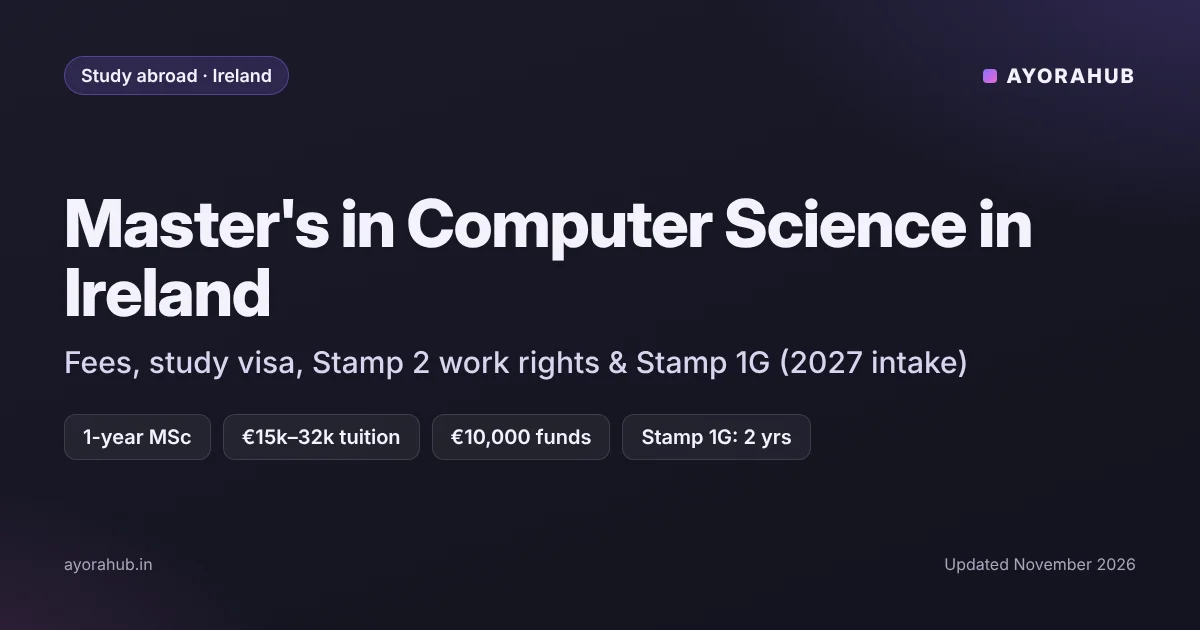
Quick answer (updated November 2026): A master’s in Computer Science in Ireland is usually a one-year taught MSc (NFQ level 9). For non-EU students, 2026/27 tuition on official university pages ranges from about €15,000 (University of Galway, MSc Computer Science & IT) to €25,000–€32,000 (DCU, UCD). For the study visa you must show access to €10,000 a year for living costs, on top of fees. On a Stamp 2 permission you can work 20 hours a week in term and 40 hours a week in holidays. After a master’s, the Third Level Graduate Programme (Stamp 1G) lets you stay to look for work for up to 24 months (granted in 12-month blocks), and the graduate salary threshold for a Critical Skills Employment Permit is €36,848.
Ireland is popular with Indian students because the degree is short, teaching is in English and Dublin is home to the European offices of many technology companies. This guide uses only official sources — the Irish Immigration Service, Citizens Information, the Department of Enterprise and the universities themselves — so you can plan with verified numbers rather than agent estimates.

Ireland for a CS master’s: the key numbers
| Item | Official figure / rule |
|---|---|
| Typical degree | Taught MSc, 1 year full-time (NFQ level 9); conversion MSc available if your bachelor’s is not in computing |
| Main intake | September for most taught MSc programmes |
| Tuition, non-EU (2026/27) | About €15,000–€32,000 depending on university and programme |
| Living-cost funds for the visa | €10,000 per year of study, in addition to fees |
| Fees before arrival | Pay the full first-year fee if under €6,000; otherwise at least €6,000 |
| Visa fee | €60 single entry / €100 multiple entry |
| Immigration registration (IRP) | €300 at first registration and at each renewal |
| Work while studying (Stamp 2) | 20 hrs/week in term; 40 hrs/week from June to September and 15 December to 15 January |
| Stay-back after a master’s | Stamp 1G, up to 24 months (12 months + 12 months), within an 8-year overall limit |
| English test | Usually IELTS Academic 6.5 overall (often 6.0 in each band) |
How much does a master’s in Computer Science cost in Ireland?
Tuition at popular universities
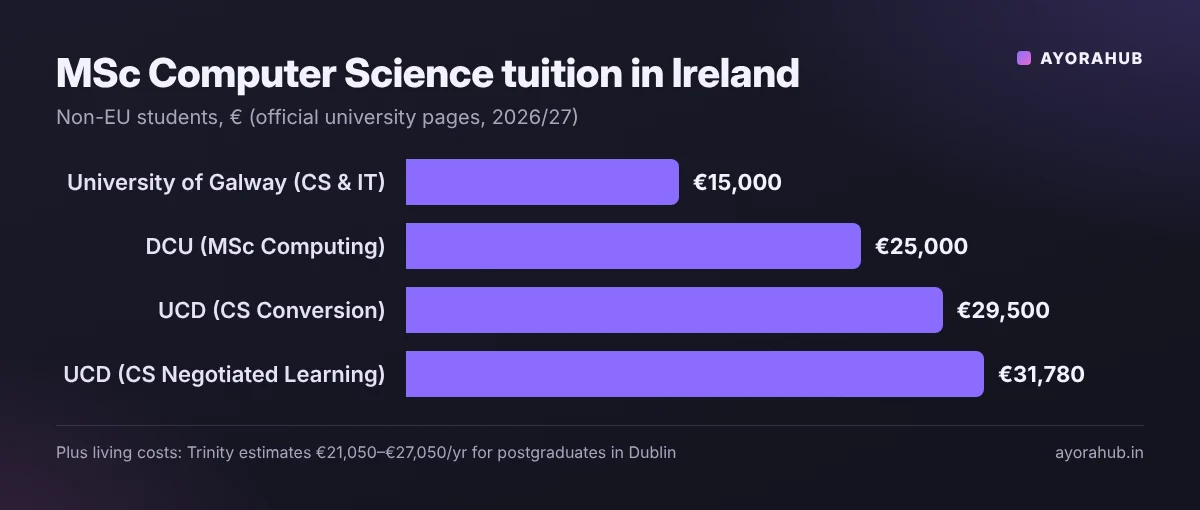
These are non-EU fees from each university’s official course or fee page. Fees rise most years, so a September 2027 entry will usually cost a little more.
| University & programme | Non-EU fee (as published) |
|---|---|
| University of Galway – MSc Computer Science & IT | €15,000 (€15,140 incl. levy), 2026/27 |
| Dublin City University (DCU) – MSc in Computing | €25,000, 2026/27; DCU lists a €5,000 scholarship for eligible non-EU applicants |
| University College Dublin (UCD) – MSc Computer Science (Conversion) | €29,500 full programme fee, 2026/27 entry |
| UCD – MSc Computer Science (Negotiated Learning) | €31,780, September 2026 intake |
| Trinity College Dublin – MSc Computer Science (strands such as Intelligent Systems, Data Science) | Published on Trinity’s postgraduate fees page; check the strand you want |
Living costs
The €10,000 the visa office asks for is a minimum, not a realistic Dublin budget. Universities publish their own estimates:
- Trinity College Dublin: €21,050–€27,050 a year for postgraduates, including accommodation, excluding tuition.
- UCD (April 2026): €1,735 (low) to €2,445 (median) a month; accommodation alone is €830–€2,250 a month.
- DCU (2026-27 fact sheet): €1,540–€1,940 a month, of which rent is €800–€1,200.
Outside Dublin (Galway, Cork, Limerick) rent is usually lower, but student housing is tight everywhere in Ireland — start looking as soon as you accept your offer.
The full first-year budget
| Item | Approximate amount |
|---|---|
| Tuition | €15,000–€32,000 |
| Living costs (Dublin, 12 months) | €21,000–€29,000 (university estimates) |
| Visa + IRP registration | €60 + €300 |
| Private medical insurance | Required at registration — compare college group schemes |
| Application fees | Set by each university — check the application portal |
Step-by-step: how to apply for a CS master’s in Ireland
- Shortlist programmes (12–10 months before). Decide between a specialist MSc (needs a computing bachelor’s) and a conversion MSc (for graduates of other subjects).
- Check entry requirements. Programmes ask for a relevant bachelor’s degree with a minimum grade set by each university, and usually IELTS Academic 6.5.
- Apply directly to each university. Irish universities use their own online portals. Trinity opened applications for 2026/27 on 1 November 2025; deadlines vary by programme (for example, Trinity’s Data Science strand lists 31 January 2027 and Intelligent Systems 30 June 2027 for September 2027 entry). Popular courses fill early, so apply in the autumn or winter before.
- Accept the offer and pay the deposit/fees. For the visa, you must pay the full first-year fee if it is under €6,000, or at least €6,000 if it is more.
- Apply for the study visa. Indian nationals need a visa. Apply online on the official AVATS system, then submit your documents. Show the €10,000 living-cost funds, fee payment, your offer letter and English results.
- Arrange private medical insurance. Many universities offer group schemes.
- Arrive and register. Register your immigration permission and get your IRP card (Stamp 2, €300). Then get a PPS number before you start working.
The study visa and Stamp 2 explained
A visa only lets you travel to Ireland; your immigration permission (Stamp 2 for full-time degree students) is what lets you stay and work. Key official rules:
- Funds: access to €10,000 for each year of study, on top of fees, plus enough to support yourself at the start of your stay.
- Insurance: private medical insurance is required at registration. Travel insurance with hospital cover may be accepted the first time, but not for renewals.
- Registration: €300 at first registration and each renewal, paid by card only.
Working during and after your studies
While you study (Stamp 2)
You can work up to 20 hours a week during term and up to 40 hours a week in the official holiday periods: June to September and 15 December to 15 January. You need a valid IRP card showing Stamp 2 and a PPS number. Part-time pay helps with living costs but should not be part of your visa funds plan.
After you graduate: Stamp 1G
The Third Level Graduate Programme lets non-EU graduates stay in Ireland to look for work. Level 8 (honours bachelor’s) graduates get 12 months. Level 9 (master’s) graduates can get up to 24 months — granted as 12 months, then a further 12 months — as long as total time on student permissions stays within 8 years. You must apply within six months of being told your result and hold a current Stamp 2 permission. On Stamp 1G you can work full-time.
Moving to a work permit
Most CS graduates move to a Critical Skills Employment Permit. From 1 March 2026 the standard minimum salary is €40,904, and recent graduates (within 12 months of the qualification) can qualify at €36,848 for an occupation on the Critical Skills list, such as many software and data roles. The job offer must be for at least two years.
Advantages and disadvantages
| Advantages | Disadvantages |
|---|---|
| One-year master’s — lower total cost and faster return to work | Housing shortage and high rents, especially in Dublin |
| Up to 2 years Stamp 1G stay-back after a master’s | One year leaves little time for internships |
| English-speaking country in the EU with a large tech sector | Tech hiring is cyclical; layoffs affect graduate roles |
| Clear permit route (Critical Skills) for software roles | Living costs well above the €10,000 visa minimum |
Common mistakes (and how to avoid them)
- Treating €10,000 as your budget. It is the visa minimum. University estimates for Dublin are more than double that.
- Weak funds evidence. Show clearly where your money comes from and that it is available to you; follow the official document checklist exactly.
- Applying late. Popular MSc courses and student housing fill up early.
- Working over the limit. Working more than 20 hours in term time can put your permission at risk.
- Relying on travel insurance. It is not accepted for renewing your permission.
Safety, privacy and limitations
- Use only official channels. Apply for the visa through the official Irish immigration system; no agent can guarantee a visa.
- Watch for rental scams. Never pay a deposit for a room you have not seen or verified.
- Protect documents. Share passport and bank details only with your university and official immigration channels.
- Rules change. Immigration rules and salary thresholds are reviewed regularly; check official pages before each step.
Beginner tips
- Compare total cost (tuition + Dublin vs non-Dublin living costs), not just tuition.
- If your bachelor’s is not in CS, look at conversion MSc programmes.
- Book IELTS early so your results are ready for the first application round.
Advanced tips
- Choose modules linked to Critical Skills occupations (software development, data, cloud, security) to make the permit route easier.
- Start applying for graduate jobs during the second semester — the one-year format leaves little time after exams.
- Plan your Stamp 1G timing: apply within six months of your result and keep your Stamp 2 valid until then.
Frequently Asked Questions
How much does a master’s in Computer Science cost in Ireland?
Non-EU tuition on official 2026/27 pages ranges from about €15,000 (University of Galway) to €32,000 (UCD), plus roughly €21,000–€29,000 a year to live in Dublin according to university estimates.
How much money do I need to show for an Irish student visa?
Access to €10,000 for each year of study for living costs, in addition to course fees. You must also have paid the full first-year fee if it is under €6,000, or at least €6,000 if it is higher.
How many hours can international students work in Ireland?
On Stamp 2, up to 20 hours a week in term time and 40 hours a week from June to September and from 15 December to 15 January.
How long can I stay in Ireland after a master’s?
Under the Third Level Graduate Programme (Stamp 1G), master’s graduates can stay up to 24 months, granted in two 12-month periods, within an 8-year overall limit on student permissions.
What salary do I need for a Critical Skills Employment Permit?
From 1 March 2026, €40,904 normally, or €36,848 for recent graduates in an occupation on the Critical Skills list.
Is a one-year master’s in Ireland recognised?
Yes. A taught MSc is a level 9 qualification on Ireland’s National Framework of Qualifications.
What IELTS score do I need?
Most CS master’s programmes ask for IELTS Academic 6.5 overall, often with at least 6.0 in each band. Check each programme.
Ireland or the UK for a CS master’s?
Both offer one-year degrees. Ireland’s stay-back for master’s graduates is up to 24 months under Stamp 1G, and it is in the EU. Compare total costs using our UK guide.
Conclusion: your next steps
Ireland suits students who want a short, English-taught master’s with a clear path into European tech jobs. Shortlist three to five programmes, check each official fee page, prepare your €10,000 funds evidence and apply early. Compare it with other destinations in our study CS abroad guide, including the Netherlands, Germany, Canada and the UK. For study help, see the best AI tools for students.
How we researched this
We used only official sources: Ireland’s Immigration Service Delivery, Citizens Information (the Irish government’s information service), the Department of Enterprise, Tourism and Employment, and the official course, fee and cost-of-living pages of Irish universities, checked in November 2026. Fees are shown for the year the university publishes; amounts for September 2027 entry may be higher. This is general information, not immigration advice — confirm every figure on the official page before you apply.
Sources
- Citizens Information – Student visas to study in Ireland
- Citizens Information – Immigration rules for full-time non-EEA students
- Immigration Service Delivery – FAQs for students
- Immigration Service Delivery – Registration: required documents
- Immigration Service Delivery – Third Level Graduate Programme
- Education in Ireland – Working in Ireland
- DETE – Critical Skills Employment Permit
- Citizens Information – Critical Skills Employment Permit
- University of Galway – MSc Computer Science
- DCU – Postgraduate fees 2026-27
- UCD – MSc Computer Science (Conversion)
- UCD – MSc Computer Science (Negotiated Learning)
- Trinity College Dublin – MSc Computer Science application requirements
- Trinity College Dublin – Cost of living
- UCD Global – Living costs