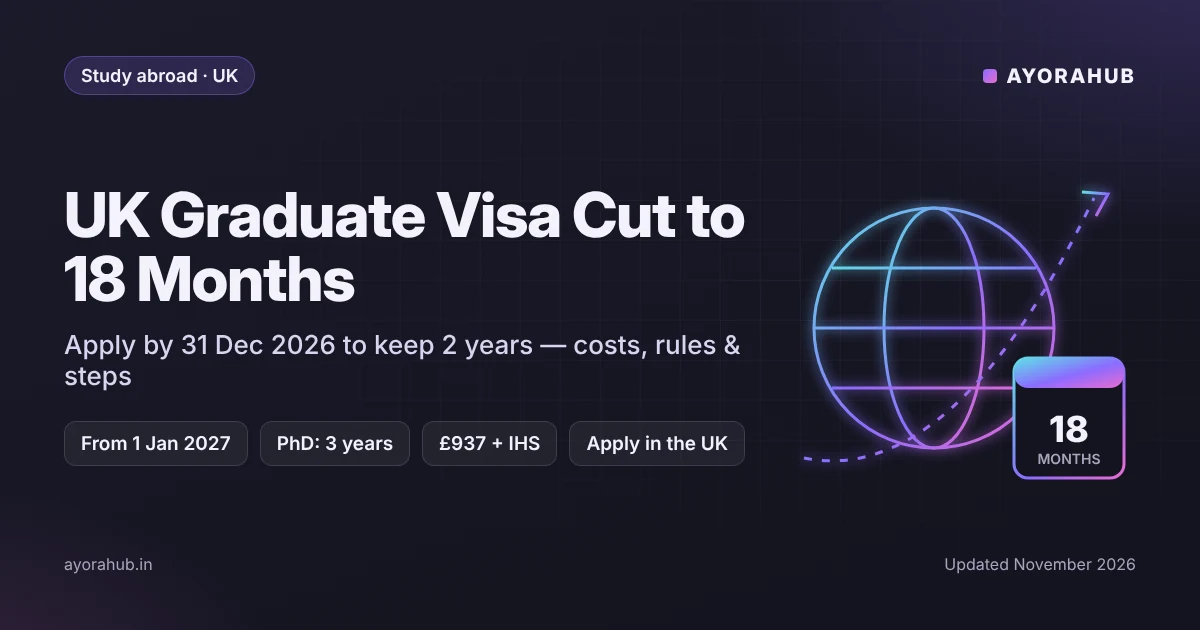
Quick answer (updated November 2026): The UK Graduate visa (Graduate Route) is changing. If you apply on or before 31 December 2026, you still get 2 years of post-study work permission after a bachelor’s or master’s degree. If you apply on or after 1 January 2027, you get 18 months. PhD graduates keep 3 years. What counts is the date you submit the application, not when your course started or ended. The visa costs £937 plus the Immigration Health Surcharge of £1,035 per year (£2,070 for 2 years, £1,552.50 for 18 months). You must apply from inside the UK while you still hold a Student visa, and only after your university has reported that you completed your course.
This is one of the biggest changes to UK post-study work since the route reopened in 2021. If you are finishing a degree in the UK — or planning to start one — this guide explains who is affected, the key dates, the exact costs, and what you can do now. Everything here comes from GOV.UK and the official Immigration Rules.
What is changing?
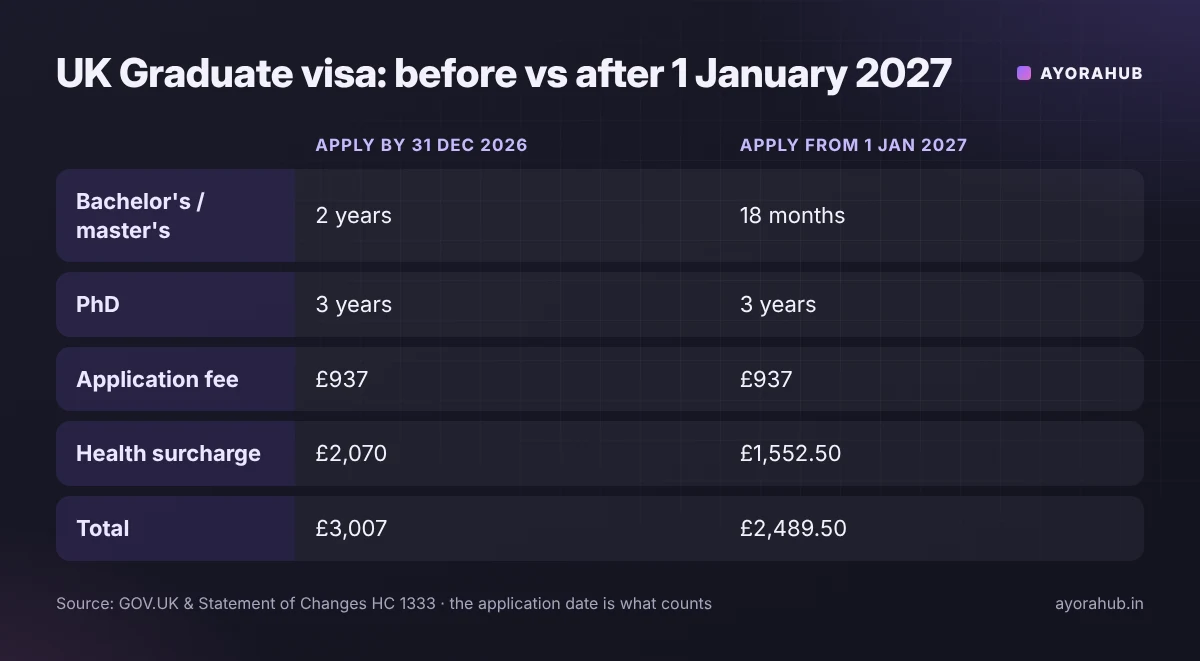
| Your degree | Apply on or before 31 Dec 2026 | Apply on or after 1 Jan 2027 |
|---|---|---|
| Bachelor’s degree | 2 years | 18 months |
| Master’s degree (taught or research) | 2 years | 18 months |
| Other eligible courses at these levels | 2 years | 18 months |
| PhD or other doctoral qualification | 3 years | 3 years (unchanged) |
The change was announced in the Statement of Changes to the Immigration Rules HC 1333 (14 October 2025). The Home Office’s explanatory memorandum confirms that it applies to applications submitted on or after 1 January 2027, and that it does not apply to anyone who applies under the Graduate route before that date.
Who is affected?
- Students finishing a one-year master’s in late 2026 (for example, a course that started in September or January) — if your university reports your completion in time and you apply by 31 December 2026, you still get 2 years.
- Students who finish in 2027 or later — you will get 18 months (unless you complete a PhD).
- Integrated PhD students who leave with a lower qualification — if you apply on or after 1 January 2027, Home Office guidance says you get 18 months, not 3 years.
- Current Graduate visa holders — nothing changes for permission you already have.
Graduate visa requirements (official)
- You must be in the UK when you apply.
- Your current permission must be a Student visa (or the older Tier 4 visa), and it must still be valid on the day you apply.
- You must have studied a UK bachelor’s degree, postgraduate degree or other eligible course for a minimum period with that Student visa.
- Your university or college must have told the Home Office you successfully completed the course.
- You cannot extend a Graduate visa, and you can only be granted it once.
How much does the Graduate visa cost?
| Cost | 2 years (apply by 31 Dec 2026) | 18 months (apply from 1 Jan 2027) |
|---|---|---|
| Application fee | £937 | £937 |
| Immigration Health Surcharge (£1,035 per year) | £2,070 | £1,552.50 |
| Total | £3,007 | £2,489.50 |
The 18-month visa is about £517.50 cheaper, but you lose six months of work permission. Fees are set by the Home Office and can change, so check GOV.UK on the day you apply.
Step-by-step: how to secure the 2-year visa before the deadline
- Check your results timeline now. Ask your university’s international student team when they will report your completion to the Home Office. You cannot apply before that happens.
- Check your Student visa expiry date. You must apply before it runs out.
- Prepare documents: passport, BRP or eVisa details, your CAS number from the Student visa, and details of any dependants who are already in the UK with you.
- Apply online on GOV.UK as soon as you are eligible — do not leave it until the last week of December, when holidays slow everything down.
- Pay the fee and the health surcharge and complete identity verification (usually through the UK Immigration: ID Check app).
- Stay in the UK (or the Common Travel Area) until you receive a decision.
The date that counts is when your online application is submitted — check the confirmation you receive.
What can you do on a Graduate visa?
- Work in most jobs, at any skill level, with no sponsor and no minimum salary
- Be self-employed or do voluntary work
- Look for a job that can sponsor a Skilled Worker visa later
- Bring family members only if they were already in the UK as your dependants on your Student visa
You cannot work as a professional sportsperson, cannot claim most public funds, and cannot extend the Graduate visa.
What 18 months means for your career plan
With 18 months, you have less time to find a job that will sponsor you for a Skilled Worker visa. Practical steps:
- Start applying during your course, not after graduation.
- Target employers that hold a sponsor licence — the Home Office publishes the register of licensed sponsors.
- Choose fields with clearer sponsorship routes (for example software, data, engineering and healthcare).
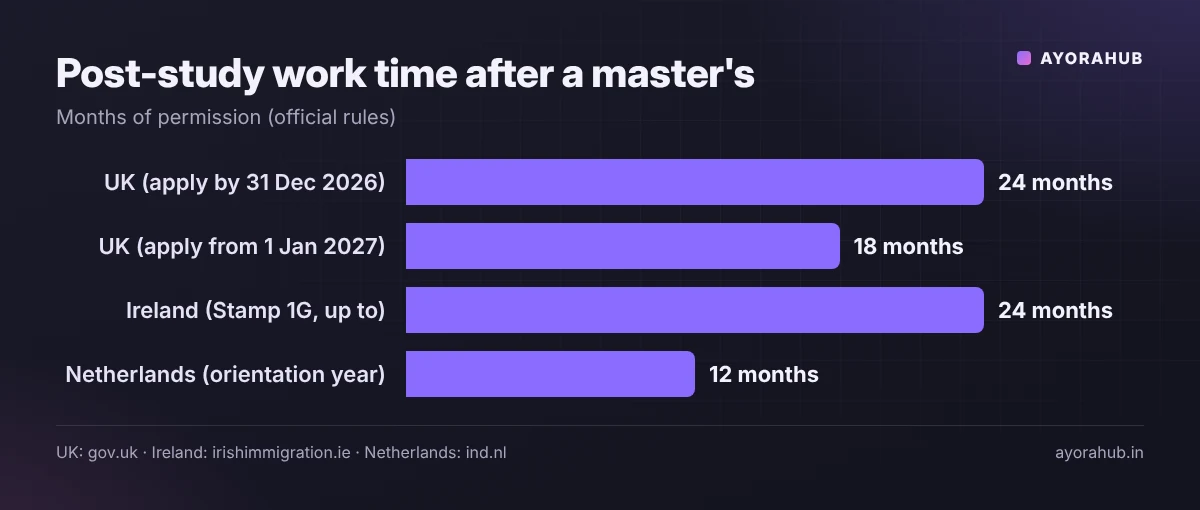
- Compare countries before you choose a course: Ireland offers up to 24 months on Stamp 1G after a master’s; the Netherlands offers a 1-year orientation year. See our Ireland guide and Netherlands guide.
Common mistakes
- Assuming the start date of your course matters — only the application date does.
- Letting the Student visa expire before applying.
- Applying before the university reports completion — the application can be refused and the fee is not refunded.
- Travelling abroad while the application is pending.
- Trusting agents’ “extension” promises — the Graduate visa cannot be extended.
Frequently Asked Questions
Is the UK Graduate visa being reduced to 18 months?
Yes. For bachelor’s and master’s graduates who apply on or after 1 January 2027, it will be 18 months instead of 2 years. PhD graduates keep 3 years.
If I apply on 31 December 2026, do I get 2 years?
Yes. Applications made on or before 31 December 2026 are decided under the old rules and get 2 years for bachelor’s and master’s graduates.
Does the 18-month rule depend on when my course started?
No. It depends only on the date you submit your Graduate visa application.
How much is the Graduate visa fee?
£937, plus the Immigration Health Surcharge of £1,035 per year — £2,070 for 2 years or £1,552.50 for 18 months.
Can I apply for the Graduate visa from India?
No. You must be in the UK and hold a valid Student visa when you apply.
Can I switch to a Skilled Worker visa later?
Yes, if you get a job with a licensed sponsor that meets the Skilled Worker requirements.
Are PhD students affected?
PhD graduates still get 3 years. Integrated PhD students who complete only a lower qualification get 18 months if they apply from 1 January 2027.
Conclusion
If you finish your degree in 2026, aim to apply before 31 December 2026 to lock in two years. If you finish later, plan for 18 months: start job-hunting early and focus on sponsor-licensed employers. For course costs and the student visa, see our MSc Computer Science in the UK guide and compare destinations in the study CS abroad guide.
How we researched this
We used only official UK government sources: GOV.UK’s Graduate visa pages (overview and costs), the Statement of Changes HC 1333 and its explanatory memorandum, Home Office caseworker guidance on the Graduate route, and Appendix Graduate of the Immigration Rules, checked in November 2026. This is general information, not immigration advice — for your own case, speak to your university’s international student adviser or a regulated immigration adviser.