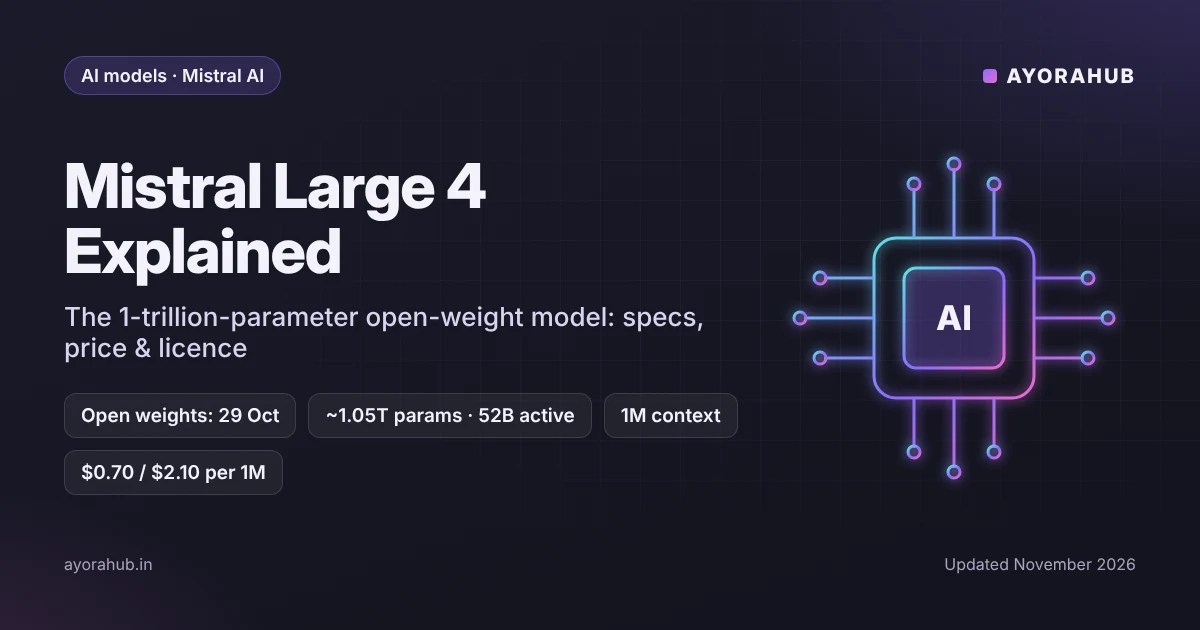
Quick answer (updated November 2026): Mistral Large 4 (nicknamed “Le Chonk”) is French AI company Mistral AI’s flagship model. Its weights were released publicly on 29 October 2026, three weeks after a public preview on 6 October. Key facts:
- Size: a Mixture-of-Experts model with about 1.05 trillion total parameters, of which about 52 billion are active per token.
- Abilities: it is natively multimodal (text and images) and supports a context window of up to 1 million tokens.
- Pricing: in Mistral’s API it costs $0.70 per million input tokens and $2.10 per million output tokens.
- Licence: it is open-weight, not fully open source. It ships under the Mistral Ecosystem Open-Weight licence, a modified MIT licence, and companies offering it as a hosted service need a separate commercial licence.
Mistral calls it the best open-weight model for coding. This guide explains in plain English what that means, how Mistral Large 4 compares with closed models like GPT-6 and Gemini 4, what hardware you would need to run it, and who should use it.
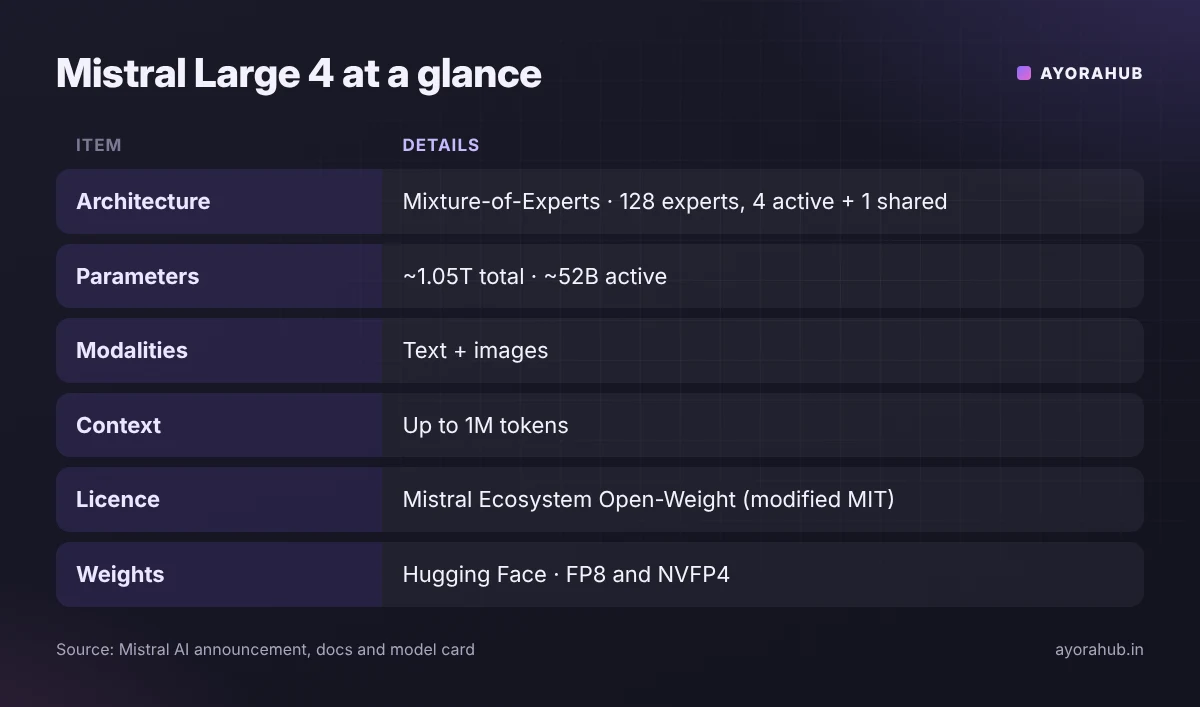
Mistral Large 4 at a glance
| Item | Details |
|---|---|
| Developer | Mistral AI (France) |
| Public preview | 6 October 2026 |
| Open weights released | 29 October 2026 |
| Architecture | Mixture-of-Experts: 128 routed experts (4 active per token) + 1 shared expert |
| Parameters | ~1.05 trillion total; ~52B active (about 49B excluding embedding and output layers) |
| Modalities | Text and images (vision encoder of about 1.6B parameters) |
| Context window | Up to 1M tokens per Mistral’s docs (some third-party providers offer less, e.g. 512K) |
| Weights | Hugging Face: FP8 checkpoint and a 4-bit NVFP4 version |
| Licence | Mistral Ecosystem Open-Weight licence (modified MIT) |
| API price | $0.70 input · $0.07 cached input · $2.10 output per 1M tokens |
What does “open-weight” mean?
A model’s weights are the billions of numbers it learned during training. When weights are released, anyone can download the model, run it on their own servers, fine-tune it and inspect how it behaves — instead of only using it through a company’s app or API.
- Open-weight: the trained model is downloadable, but the licence may add conditions, and training data and code are usually not released.
- Open source (in the strict sense): usually means a standard, unrestricted licence and often more of the training recipe.
Mistral Large 4’s licence is based on MIT with one notable condition: businesses that offer the model to others as a hosted Model-as-a-Service need a separate commercial licence from Mistral. Using it inside your own company or product is broadly permitted, but read the licence before commercial use.
What is a Mixture-of-Experts (MoE) model?
Instead of one giant network doing all the work for every word, an MoE model contains many smaller “expert” networks. For each token, a router picks a few experts — here, 4 of 128, plus a shared expert. So although Mistral Large 4 stores about a trillion parameters, it only uses about 52 billion for each token. That makes it much cheaper to run than a dense trillion-parameter model, although it still needs enough memory to hold all the weights.
How good is it?
Mistral reports that post-preview training improved coding, and claims leading open-weight results on agentic coding benchmarks — for example 41% on Terminal-Bench 4.0 and 48% on the Artificial Analysis Coding Agent Index. These are self-reported figures; independent tests may differ, and benchmark scores do not always reflect real-world work.
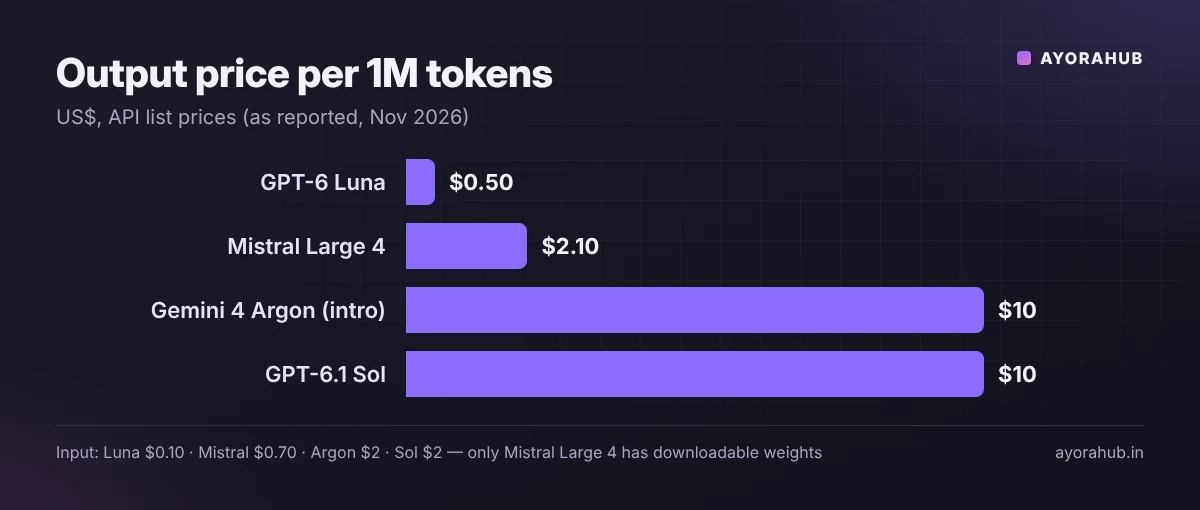
Price comparison with closed models
| Model | Input / output price per 1M tokens | Weights downloadable? |
|---|---|---|
| Mistral Large 4 (Mistral API) | $0.70 / $2.10 | Yes |
| Gemini 4 Argon (intro price until 30 Nov 2026, as reported) | $2 / $10 | No |
| GPT-6.1 Sol (as reported) | $2 / $10 | No |
| GPT-6 Luna (as reported) | $0.10 / $0.50 | No |
Prices are per million tokens and change often. More detail: Gemini 4 Argon vs Carbon and GPT-6 models explained.
How to use Mistral Large 4
1. Through Mistral’s API or chat app
The easiest option for most developers and businesses: create an account on Mistral’s platform, generate an API key and call the model. Mistral’s documentation lists the current model ID and limits. Mistral’s chat assistant, Le Chat, is the simplest way to try its models without code.
2. Self-host the open weights
Download the weights from Mistral’s Hugging Face organisation. Two official checkpoints are published: FP8 and a smaller 4-bit NVFP4 version. Community-quantised versions (for example GGUF builds) also exist, but use official files for production.
Hardware reality check (our estimate): at FP8, one byte per parameter means roughly 1 TB of weights; the 4-bit version needs roughly half of that, plus memory for the context cache. That is data-centre territory — typically a multi-GPU server — not a laptop or gaming PC.
3. Through cloud and model platforms
Third-party providers and model routers also host it; check their context limits and prices, which can differ from Mistral’s own.
Who should use Mistral Large 4?
- Companies with data-sovereignty needs — for example in Europe or regulated sectors — that want to run a frontier-class model on their own infrastructure.
- Developers building coding agents who want a strong, lower-cost model.
- Researchers who need access to weights for fine-tuning or evaluation.
- Not ideal for: individuals wanting to run AI on a personal computer — smaller open models are far more practical.
Advantages and limitations
| Advantages | Limitations |
|---|---|
| Downloadable weights — run privately, fine-tune | Huge hardware requirements to self-host |
| Low API price compared with closed frontier models | Licence restricts hosted Model-as-a-Service use without a deal |
| 1M-token context, text + images | Benchmarks are self-reported so far |
| Strong focus on coding and agents | Smaller ecosystem of apps than ChatGPT or Gemini |
Common mistakes
- Calling it “open source” in contracts — check the actual licence terms.
- Assuming you can run it on a laptop — you cannot; use the API or a smaller model.
- Using unofficial weight files in production without verifying their source.
- Comparing prices without counting output tokens — reasoning-heavy tasks produce many output tokens.
Frequently Asked Questions
Is Mistral Large 4 open source?
It is open-weight: the weights are downloadable under the Mistral Ecosystem Open-Weight licence, a modified MIT licence with conditions for Model-as-a-Service providers.
How many parameters does Mistral Large 4 have?
About 1.05 trillion in total, with about 52 billion active per token (about 49 billion excluding embedding and output layers).
What is the context window of Mistral Large 4?
Up to 1 million tokens according to Mistral; some third-party providers offer a smaller limit.
How much does the Mistral Large 4 API cost?
$0.70 per million input tokens, $0.07 per million cached input tokens and $2.10 per million output tokens, per Mistral’s announcement.
Can I run Mistral Large 4 on my PC?
Not realistically. Even the 4-bit version needs hundreds of gigabytes of GPU memory.
Why is it called “Le Chonk”?
It is Mistral’s playful nickname for the model, referring to its very large size.
Conclusion
Mistral Large 4 is a milestone for open-weight AI: a trillion-parameter, multimodal, long-context model that anyone can download — and a much cheaper API option than most closed frontier models. For most people, the API is the practical way to use it; self-hosting is for organisations with serious GPU infrastructure. Compare it with other assistants in the best AI chatbots of 2026, and see how AI agents use models like this in our REA explainer.
How we researched this
We used Mistral AI’s official announcement and model documentation, and the official model cards on Hugging Face, checked in November 2026. Benchmark results are Mistral’s own; the hardware estimate is our calculation from parameter counts. Competitor prices come from our earlier articles and are as reported.