Quick answer (updated November 2026): What is CAPTCHA? CAPTCHA stands for “Completely Automated Public Turing test to tell Computers and Humans Apart.” It is a check websites use to stop bots from spamming forms, creating fake accounts or guessing passwords. Older CAPTCHAs asked you to type distorted letters or pick pictures. Modern systems such as Google reCAPTCHA (including the score-based v3) and Cloudflare Turnstile mostly work in the background and only show a challenge when something looks unusual. Warning: a real CAPTCHA will never ask you to press keyboard shortcuts, paste commands into Windows Run or Terminal, or download a file. That is a scam.
Searches for “captcha meaning” have tripled this year, partly because people keep getting stuck on verification pages and partly because of fake-CAPTCHA scams. Here is what CAPTCHA is, how the main types work, why you sometimes fail them, and how to stay safe.
What does CAPTCHA mean?
The term was coined in the early 2000s by researchers at Carnegie Mellon University. A “Turing test” checks whether a machine can pass as human. A CAPTCHA reverses that idea: a computer sets a test that humans pass easily but automated programs find hard.
Websites use CAPTCHAs to protect:
- Sign-up and login pages from fake accounts and password-guessing attacks
- Comment sections and contact forms from spam
- Ticket and product sales from scalper bots
- Online polls and coupons from automated abuse
Types of CAPTCHA
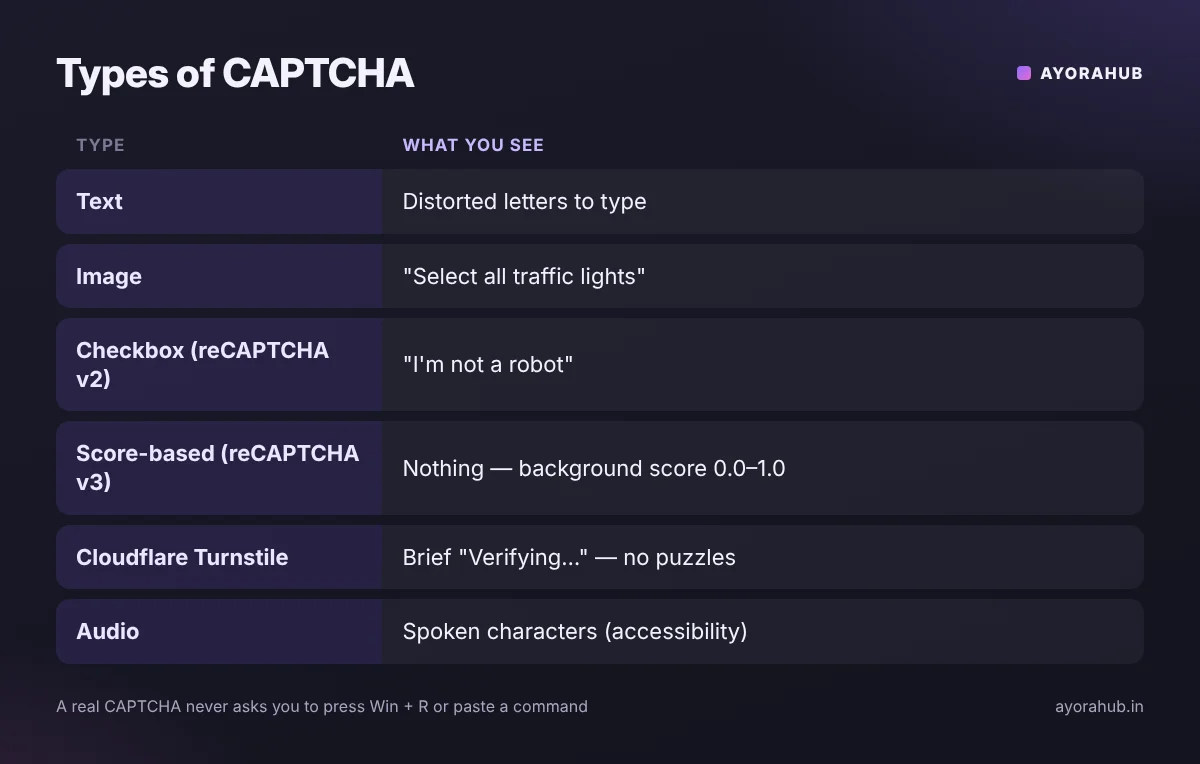
| Type | What you see | How it works |
|---|---|---|
| Text CAPTCHA | Distorted letters and numbers to type | Hard for old OCR software to read; now often solved by AI, so less used |
| Image CAPTCHA | “Select all squares with traffic lights” | Visual recognition task |
| Checkbox (reCAPTCHA v2) | “I’m not a robot” box | Passes you immediately or shows a challenge, based on risk signals |
| Score-based (reCAPTCHA v3) | Usually nothing | Runs in the background and gives each request a score from 0.0 to 1.0; the website decides what to do with a low score |
| Cloudflare Turnstile | A brief “Verifying…” widget, sometimes a click | Runs non-intrusive browser challenges without puzzles; free to use |
| Audio CAPTCHA | Spoken characters | Accessibility alternative for people who cannot see images |
How modern CAPTCHA works (reCAPTCHA v3 and Turnstile)
Bots got good at solving puzzles, and puzzles annoy real people. So modern systems look at signals instead — how the browser behaves, whether it runs scripts normally, and other risk factors the providers do not fully disclose.
- reCAPTCHA v3 returns a score; Google’s documentation explains that the lower the score, the more likely the visitor is a bot. The site might then ask for extra verification, slow down requests or block them. Google now labels v2 and v3 keys as legacy within its newer reCAPTCHA product, which has a free tier (10,000 assessments a month, per Google’s docs).
- Cloudflare Turnstile is free for unlimited use in “managed” mode, works without routing traffic through Cloudflare, and does not show image puzzles. Cloudflare says it does not use the data for ad retargeting.
Why do I keep failing CAPTCHAs?
- VPN or proxy: shared IP addresses used by many people (and bots) look risky.
- Blocked cookies or scripts: strict privacy extensions can stop the check from running.
- Outdated browser: update Chrome, Edge, Firefox or Safari.
- Unusual activity: many quick requests from your network (for example, a busy college or office Wi-Fi).
- Automation or remote-desktop tools running in the background.
Fixes: turn off the VPN for that site, allow cookies and JavaScript for it, disable extensions one by one, update the browser, or try mobile data instead of shared Wi-Fi.
Fake CAPTCHA scams: how to spot them
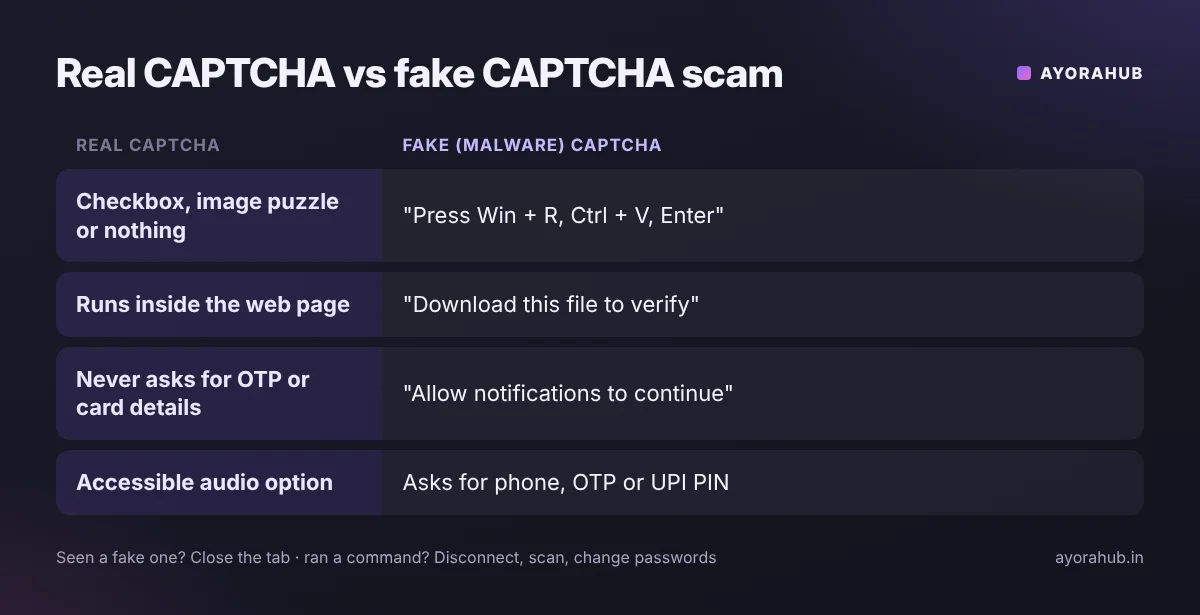
Criminals copy the look of CAPTCHA pages to trick people into running malware. Red flags:
- Instructions to press Windows + R, Ctrl + V and Enter, or to paste something into Terminal/PowerShell
- “Download this file to verify you are human”
- Requests to allow browser notifications to “prove you are not a robot”
- Asking for your phone number, OTP, card or UPI details
If you see any of these, close the tab. If you already ran a command, disconnect from the internet, run a full antivirus scan and change important passwords from another device.
For website owners: which CAPTCHA should you use?
| Option | Good for | Note |
|---|---|---|
| Cloudflare Turnstile | Small sites and blogs that want free, low-friction protection | No puzzles; free |
| Google reCAPTCHA | Sites already using Google services; score-based risk decisions | Free tier, then paid |
| Honeypot fields + rate limiting | Simple contact forms | Invisible to users; combine with the above |
Whatever you choose, keep an accessible alternative for users with disabilities, and do not put CAPTCHAs on every page — it hurts real visitors.
Advantages and limitations of CAPTCHA
| Advantages | Limitations |
|---|---|
| Cuts spam and fake sign-ups | AI can now solve many visual puzzles |
| Slows down password-guessing attacks | Frustrating, especially on mobile |
| Modern versions are mostly invisible | Accessibility problems for some users |
| Free options exist | Privacy concerns about background signals |
Frequently Asked Questions
What is the full form of CAPTCHA?
Completely Automated Public Turing test to tell Computers and Humans Apart.
What is the meaning of CAPTCHA in simple words?
A quick check that a website uses to make sure a real person, not a bot, is using a form or page.
What does “I’m not a robot” do?
It is Google’s reCAPTCHA v2 checkbox. Based on risk signals, it lets you through immediately or shows an image challenge.
Why does Google say “unusual traffic from your computer network”?
Your network or IP sent many automated-looking requests — often due to a VPN, shared Wi-Fi or malware. Turn off the VPN and scan your device.
Can a CAPTCHA ask me to run a command?
Never. Any “verification” asking you to press Win + R or paste a command is a malware scam.
Is Cloudflare Turnstile free?
Yes. Cloudflare says Turnstile’s managed mode is free for unlimited use, even for sites that are not Cloudflare customers.
Conclusion
CAPTCHAs are the internet’s bouncer: mostly invisible now, occasionally annoying, and important against bots. Learn the difference between a real check and a fake one, and you will avoid one of 2026’s most common malware tricks. Related reading: what SSO login is, how to stay safe with QR codes and the best AI chatbots of 2026.
How we researched this
We used Google’s official reCAPTCHA documentation, Cloudflare’s Turnstile announcements and learning centre, checked in November 2026. Providers do not publish every signal they use, so descriptions of how scoring works are kept general.