

Quick answer (updated November 2026): To learn programming in 2026, first pick one language for a clear goal:
- Python for AI, data and automation.
- JavaScript for websites and apps.
- C++ or Java for data structures and algorithms (DSA) and Indian campus placements.
- PHP for WordPress and web freelancing.
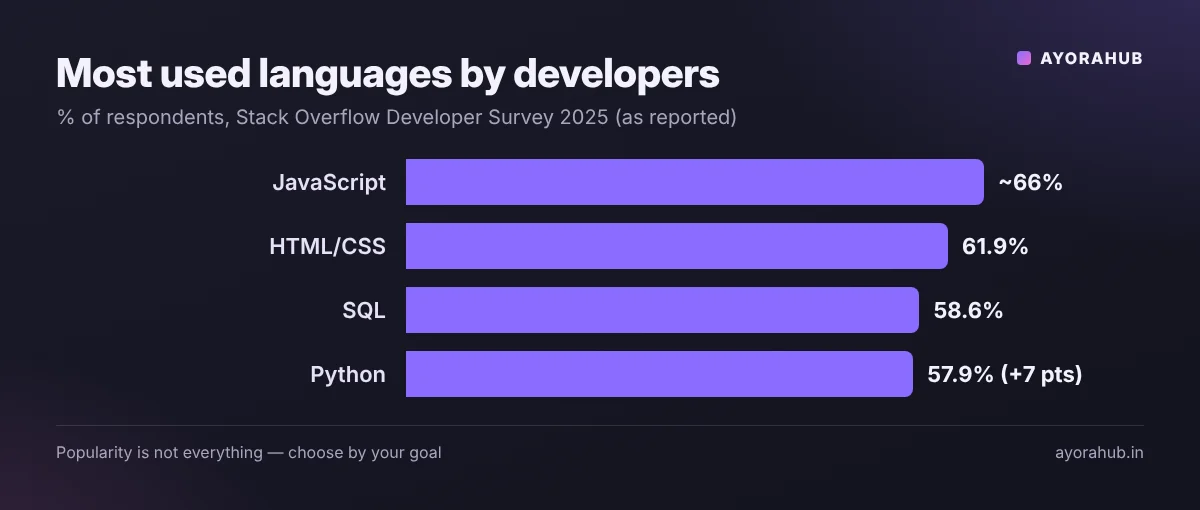
Then learn the fundamentals with a free, structured course such as Harvard’s CS50, freeCodeCamp or The Odin Project. Code every day, and build small projects from the first month. In the Stack Overflow 2025 survey, JavaScript (about 66% of developers) and Python (about 58%, up sharply) were among the most used languages. Use AI assistants to explain errors, not to write everything for you.
“Learn programming”, “cpp”, “java” and “php” are all rising searches this year. This guide gives you a practical roadmap: which language first, the best free resources, a 90-day plan and the mistakes that make most beginners quit.
Step 1: Choose your goal, then your first language
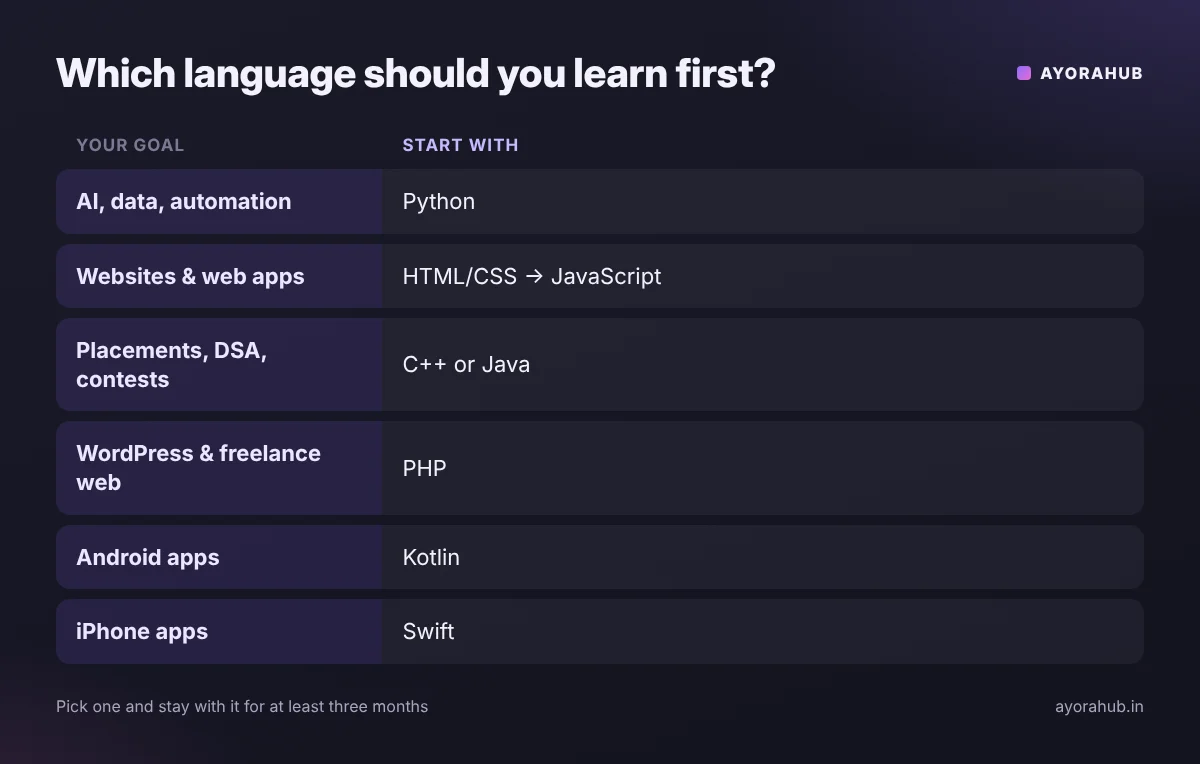
| Your goal | Start with | Why |
|---|---|---|
| AI, machine learning, data analysis | Python | Simple syntax; the main language for AI and data libraries |
| Websites and web apps | HTML/CSS → JavaScript | Runs in every browser; also on servers with Node.js |
| Campus placements, DSA, competitive programming | C++ or Java | Most used in interview and contest preparation |
| WordPress sites, freelance web work | PHP | Powers WordPress — see what is PHP |
| Android apps | Kotlin | Google’s preferred language for Android |
| iPhone apps | Swift | Apple’s language for iOS |
| Not sure yet | Python | Easiest start; skills transfer to other languages |
The first language matters less than people think. Variables, loops, functions, data structures and debugging work almost the same everywhere. Pick one and stay with it for at least three months.
Step 2: Learn the fundamentals (in this order)
- Variables, data types (integers, strings, booleans) and operators
- Conditions (
if/else) and loops (for,while) - Functions and scope
- Lists/arrays, dictionaries/maps
- Reading errors and debugging
- Files, input/output and simple APIs
- Basic data structures and algorithms (searching, sorting, recursion)
- Version control with Git and GitHub — see our GitHub guide
Step 3: Use the best free resources
| Resource | Best for | Cost |
|---|---|---|
| Harvard CS50 (CS50x) | Strong computer science foundation (C, Python, SQL, web) | Free to audit |
| freeCodeCamp | Web development, JavaScript, Python, certifications | Free |
| The Odin Project | Full-stack web development with real projects | Free |
| MDN Web Docs | HTML, CSS and JavaScript reference | Free |
| Official Python tutorial (python.org) | Python basics | Free |
| NPTEL (India) | University-style programming courses from IITs | Free to learn; fee for the certificate exam |
A 90-day beginner plan
| Weeks | Focus | Mini project |
|---|---|---|
| 1–2 | Setup, variables, conditions, loops | Number-guessing game |
| 3–4 | Functions, lists/arrays, strings | To-do list in the terminal |
| 5–6 | Dictionaries/maps, files, error handling | Expense tracker that saves to a file |
| 7–8 | Git and GitHub; reading documentation | Put all projects on GitHub with a README |
| 9–10 | Your track: web (HTML/CSS/JS), data (pandas) or DSA | Personal web page / data analysis of a CSV / 30 easy DSA problems |
| 11–12 | One bigger project | A small app you would actually use |
One to two focused hours a day is enough. Consistency beats long weekend sessions.
How to use AI while learning to code
- Do: ask AI to explain an error message, a concept or someone else’s code; ask for hints and practice problems.
- Do: write the code first yourself, then ask AI to review it.
- Don’t: paste every assignment into a chatbot — you will not learn to solve problems, and interviews will expose it.
- Tools: GitHub Copilot has a free tier, and chatbots like ChatGPT and Claude explain code well. See the best AI tools for students.
Common mistakes that make beginners quit
- Tutorial hell: watching course after course without building anything.
- Switching languages every month.
- Skipping fundamentals to jump into frameworks.
- Fear of errors — reading error messages is programming.
- Learning alone with no feedback — share code on GitHub, join a community, ask for reviews.
Beginner and advanced tips
- Beginner: type code yourself instead of copy-pasting; explain your code out loud.
- Beginner: keep a “bugs I fixed” note — it becomes your personal guide.
- Advanced: read other people’s code on GitHub, contribute small fixes to open-source projects, and learn testing.
- Advanced: for placements, practise DSA regularly and do mock interviews; for jobs, build two or three solid portfolio projects.
Frequently Asked Questions
Which programming language should I learn first?
Python if you are unsure or interested in AI and data; JavaScript for web development; C++ or Java for DSA and placements.
Can I learn programming for free?
Yes. CS50, freeCodeCamp, The Odin Project, MDN and the official Python tutorial are all free.
How long does it take to learn programming?
Basics take about 2–3 months of daily practice; becoming job-ready usually takes 6–12 months or more, depending on your goal and effort.
Is C++ or Java better for placements?
Both work. C++ is popular for competitive programming; Java is common in enterprise jobs. Choose one and master DSA in it.
Do I need maths to learn programming?
Basic school maths is enough to start. AI, graphics and competitive programming need more maths later.
Will AI replace programmers?
AI tools now write a lot of routine code, but people who understand problems, design systems and check AI output remain in demand. Learning the fundamentals is what lets you use AI well.
Conclusion
Pick one goal and one language, learn the fundamentals with a free course, build something every week and put it on GitHub. That simple loop — learn, build, share, repeat — is how most self-taught and college programmers improve fastest.
How we researched this
We used the Stack Overflow Developer Survey 2025, official course pages (CS50, freeCodeCamp, The Odin Project, NPTEL) and language documentation. Survey percentages are as reported for all respondents; career outcomes vary by person and market.

Comments are closed.