

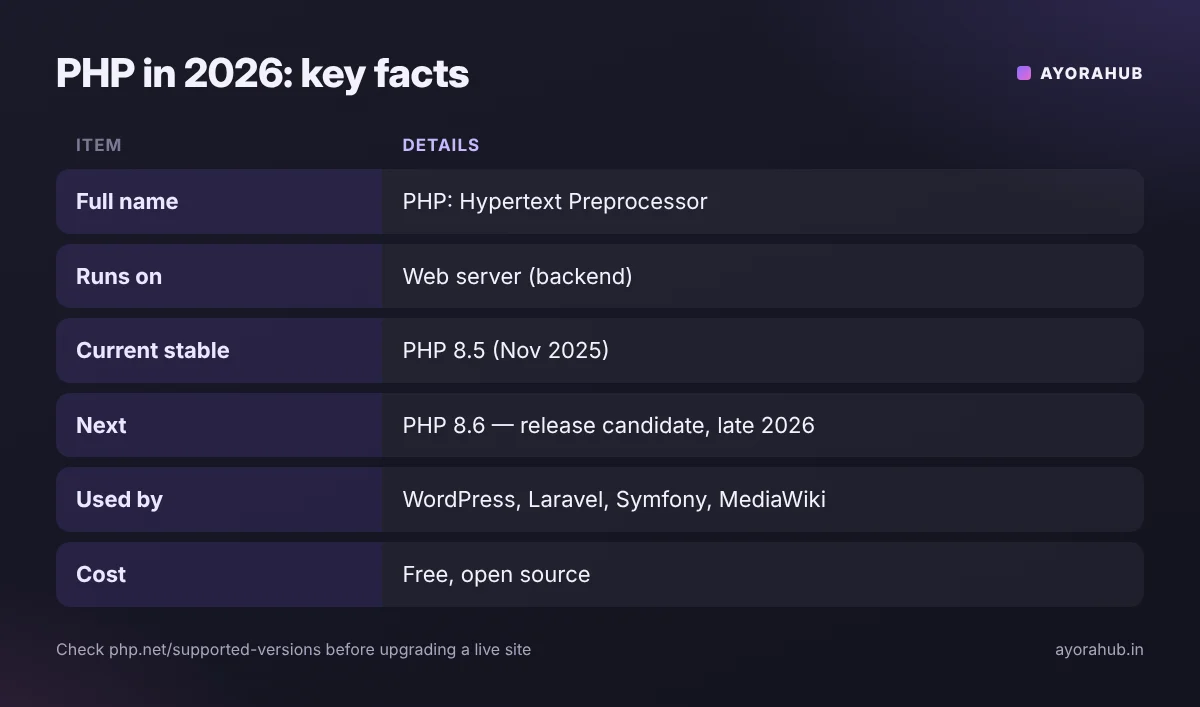
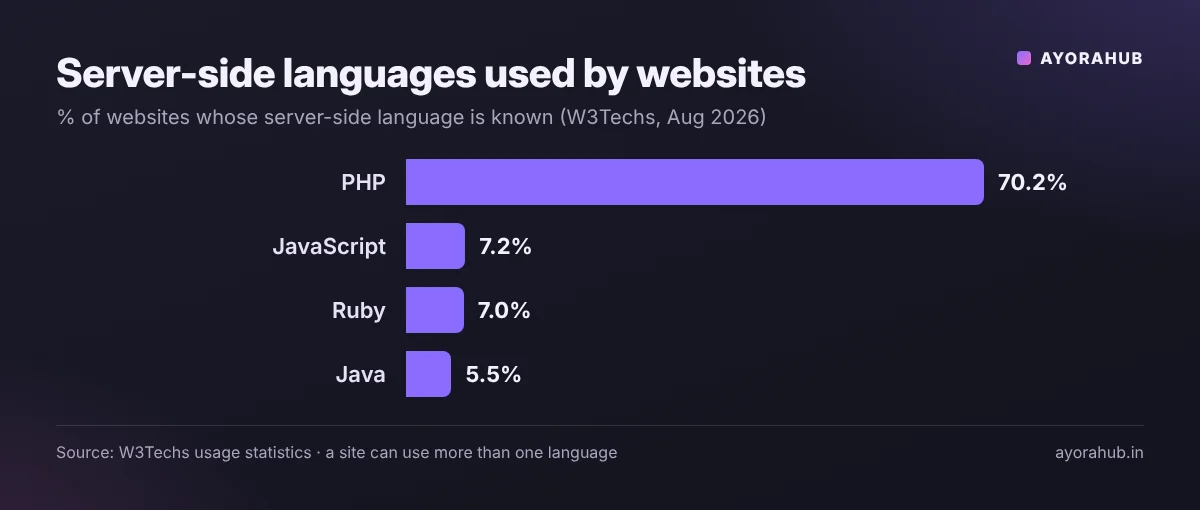
Quick answer (updated November 2026): What is PHP? PHP (“PHP: Hypertext Preprocessor”) is a free, open-source programming language. It runs on a web server and builds web pages before they reach your browser. It powers WordPress, Wikipedia’s MediaWiki and frameworks such as Laravel and Symfony. According to W3Techs (August 2026), PHP is used by about 70% of websites whose server-side language is known. The current stable branch is PHP 8.5 (released November 2025), and PHP 8.6 is in release-candidate testing for late 2026. PHP is worth learning if you want to build websites, work with WordPress or do freelance web projects.
“What is PHP” is one of the fastest-growing programming searches this autumn, often from students who meet it in a college course or while editing a WordPress site. This beginner’s guide explains what PHP does, shows real code, and helps you decide whether to learn it in 2026.
What does PHP do?
When you open a website, your browser asks a server for a page. If the site uses PHP, the server runs the PHP code first, and the result is sent to your browser. The code might read from a database, check whether you are logged in, or show the latest posts. Your browser only receives plain HTML, so you never see the PHP code itself.
That is the key difference from JavaScript in the browser: JavaScript usually runs on your device, while PHP runs on the server.
A first PHP example
<?php
$name = "Ayora";
$hour = (int) date("G");
$greeting = $hour < 12 ? "Good morning" : "Hello";
echo "<h1>$greeting, $name!</h1>";
?>
The server runs this and sends <h1>Good morning, Ayora!</h1> (or “Hello”) to the browser.
What is PHP used for?
- Content management systems: WordPress, Drupal, Joomla. WordPress themes and plugins are written in PHP.
- Web applications and APIs: with frameworks like Laravel and Symfony.
- E-commerce: WooCommerce, Magento (Adobe Commerce).
- Large sites: Wikipedia’s MediaWiki software is written in PHP.
- Forms, logins and dashboards on countless small business sites.
PHP versions in 2026
| Version | Status (as reported, November 2026) |
|---|---|
| PHP 8.6 | Release candidate since September 2026; stable release expected late 2026 |
| PHP 8.5 | Current stable branch (released 20 November 2025) |
| PHP 8.4 | Supported |
| PHP 8.3 | Security fixes only |
| PHP 8.2 and older | End of life or ending — upgrade |
Always confirm on php.net’s “Supported Versions” page. Running an unsupported version means no security fixes — a common reason small sites get hacked. W3Techs also shows that many websites still run PHP 7 or older, which is risky.
How to start learning PHP (step by step)
- Learn basic HTML and CSS first — PHP’s job is to produce HTML.
- Install PHP locally. Easiest options: a bundle such as XAMPP, or install PHP and run the built-in development server with
php -S localhost:8000in your project folder. - Use a code editor such as Visual Studio Code with a PHP extension.
- Learn the core: variables, arrays, loops, functions, forms (
$_GET/$_POST), sessions. - Connect to a database (MySQL/MariaDB) with PDO and prepared statements.
- Build a small project: a to-do list, a contact form, a simple blog.
- Then pick a framework (Laravel is the most beginner-friendly), or learn WordPress theme/plugin development.
The official PHP manual at php.net is free, detailed and includes examples for every function.
Is PHP dead in 2026?
No. “PHP is dead” has been said for over a decade, but usage data tells a different story: around 70% of websites with a known server-side language still use it, largely because of WordPress. The language has modernised a lot since PHP 7 and 8 — with a JIT compiler, typed properties, enums, attributes and much better performance.
What is true: new start-ups and AI products more often choose JavaScript/TypeScript (Node.js) or Python. So PHP is a great choice for web and WordPress work and freelancing, but not the main language for AI or data science.
PHP vs other languages
| Language | Best for | Where it runs |
|---|---|---|
| PHP | Websites, WordPress, web apps | Server |
| JavaScript | Interactive web pages; servers with Node.js | Browser and server |
| Python | AI, data science, automation, back-ends | Server / your computer |
| Java | Enterprise systems, Android, DSA in interviews | Server / devices |
Not sure where to begin? Read how to learn programming in 2026.
Advantages and disadvantages of PHP
| Advantages | Disadvantages |
|---|---|
| Free, open source, runs on almost all web hosting | Older tutorials teach insecure habits |
| Huge ecosystem (WordPress, Laravel) | Less used for AI and data science |
| Easy to deploy — upload files and it runs | Inconsistent function names in older parts of the language |
| Fast in modern versions (PHP 8+) | Many legacy codebases on outdated versions |
Common beginner mistakes (and security tips)
- Putting user input straight into SQL — use prepared statements to prevent SQL injection.
- Printing user input without escaping — use
htmlspecialchars()to prevent cross-site scripting (XSS). - Storing plain-text passwords — use
password_hash()andpassword_verify(). - Learning from 2010-era tutorials that use removed
mysql_*functions. - Leaving error messages visible on a live site.
Frequently Asked Questions
What is PHP in simple words?
A programming language that runs on a web server and builds web pages before they are sent to your browser.
What does PHP stand for?
“PHP: Hypertext Preprocessor” — a recursive name. It originally stood for “Personal Home Page”.
What is the latest PHP version?
PHP 8.5 is the current stable branch (released November 2025); PHP 8.6 is in release-candidate testing for late 2026. Check php.net for the latest patch.
Is PHP frontend or backend?
Backend. It runs on the server; HTML, CSS and JavaScript handle the frontend.
Is PHP worth learning in 2026?
Yes, if you want web development, WordPress or freelance work. For AI and data science, start with Python instead.
Is PHP free?
Yes. PHP is open source and free to use.
Conclusion
PHP remains one of the most practical skills for building websites: it is free, runs nearly everywhere, and is the language behind WordPress. Learn the basics, use a supported version, follow modern security practices, and build small projects. AI assistants can speed up learning — see GitHub Copilot and AI coding tools — and to share your projects, learn how GitHub works.
How we researched this
We used the official PHP documentation and release information, W3Techs usage statistics (August 2026), and reports of the PHP 8.6 release-candidate schedule. Version support dates change; confirm them on php.net before upgrading a live site.

Comments are closed.